
Split system air conditioning install, done properly
A split system is two units and the pipework that joins them. The head sits on the wall inside. The outdoor unit goes on a bracket or a slab outside. Between them run insulated copper pipes, a drain line and a control cable, and the whole lot gets wired back to your switchboard on its own circuit. Get any part of that wrong and you find out months later, usually as a drip down the inside wall or a safety switch that trips every time the compressor kicks in.
We fit split systems in houses, units, granny flats and small business premises across Brisbane's north side. Warner is home base, and we work a tight patch from Albany Creek out to Narangba and Burpengary, then east across to Redcliffe. Short drives. That's how we hold a booking time.
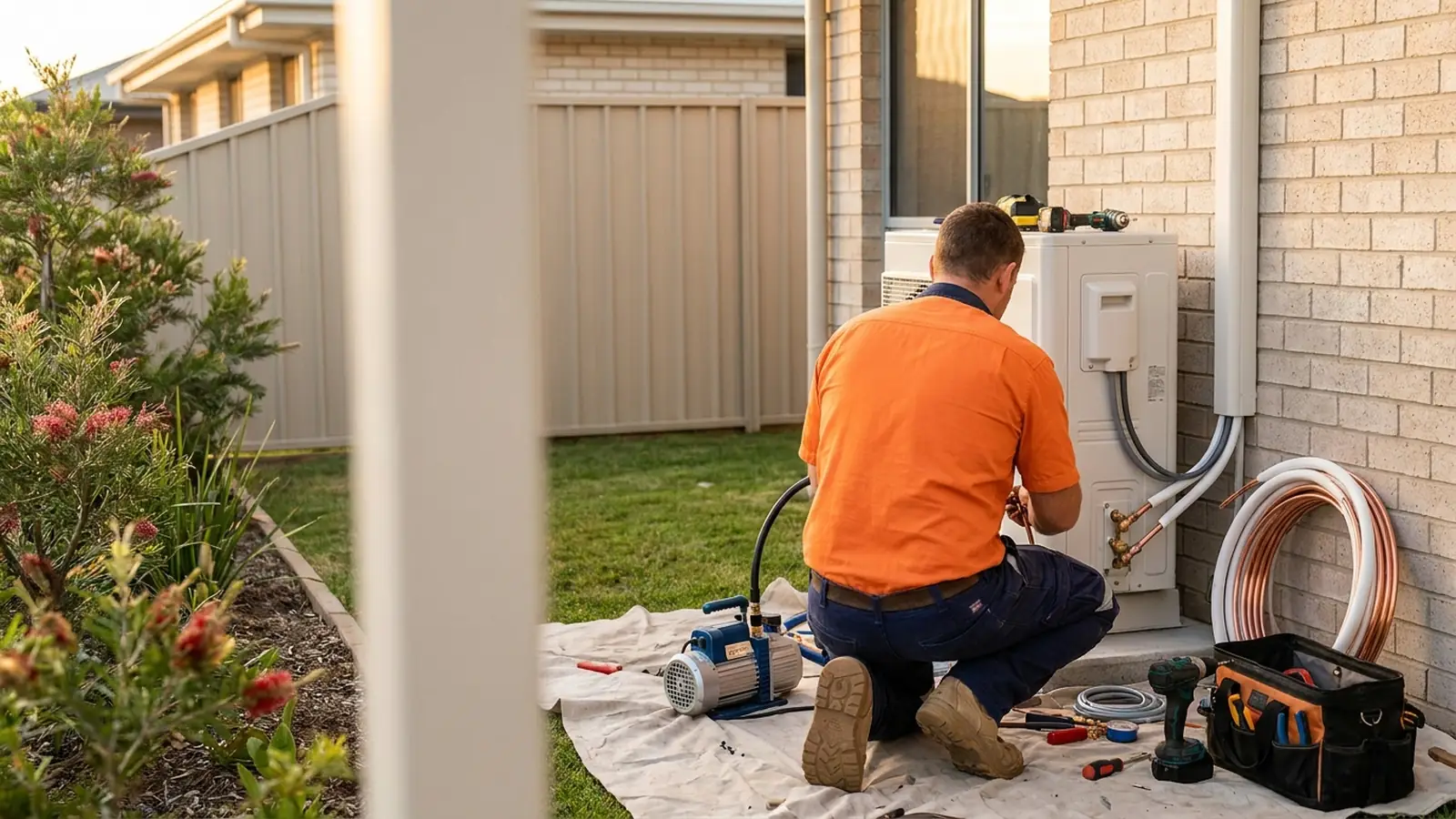
The job covers the lot: mounting the head, setting the outdoor unit, drilling and sealing the wall penetration, running and lagging the pipework, getting the drain to fall the right way, wiring the unit back to the board on its own circuit with a safety switch, then vacuuming the lines, releasing the gas and testing the unit before we pack up. You get the remote, a quick run through how it works, and a swept floor.
Bought your own unit from a retailer? We'll install it. Plenty of people go that way and it's no trouble at all. Haven't bought yet? Ring us first and tell us about the room. Capacity matters more than the badge on the box, and an undersized unit in an open plan living area will sit flat out all afternoon and never quite get there.
The north side gives air conditioners a hard time. Summer runs humid from November through March, and the storms that come across Moreton Bay leave the air thick for days afterwards. Newer estate homes in North Lakes and Mango Hill have big west-facing glass, dark roofs and not much shade yet, so the living room holds heat long after dark. Older lowset brick and timber places around Strathpine and Petrie usually have thin ceiling insulation and a switchboard that was never built to carry an air conditioner. Out at Redcliffe, salt air works on an outdoor unit's casing and fixings if it's mounted in the wrong spot.
What people notice before they call us
Most calls start the same way. One room in the house is unliveable by four in the afternoon, or an old unit has finally packed it in, or someone's opened the switchboard and realised there's nowhere for an aircon circuit to go.
The one hot room is the classic. Usually a west-facing bedroom or a rear extension that was added on later with a flat roof and no eaves. Fans and portable units push the air around without pulling the humidity out of it, so the room stays sticky even when the temperature drops a bit. A split system takes moisture out as it cools, which is why the room feels different within about ten minutes. Kids' bedrooms and home offices are the two rooms we get asked about most.
Old units get loud, then they leak. Wall box units and early splits go noisy as the fan bearings wear and the rubber feet under the outdoor unit perish. Water running down the inside wall is nearly always the drain: blocked with dust and slime, run with no fall, or sagging somewhere in the middle and holding water. On a changeover we replace the drain rather than reuse it. A new unit on a tired old drain line just moves the problem down the road.
Then there's the safety switch that trips when the aircon kicks in. A compressor pulls a solid hit of current at start-up. If the unit is sharing a circuit with power points, or the board is an old ceramic fuse board with one main switch and no RCDs, that surge shows up as nuisance tripping. Sometimes it's a real fault inside the unit. Either way it's work for a licensed electrician, not something to reset over and over and hope about. We see plenty of it in the older streets around Strathpine, Petrie and Kallangur.
Salt is the bayside problem. At Redcliffe and the streets closest to the water, salt in the air gets into the outdoor unit's fins, casing and screws. A unit mounted on a shaded south or east wall, up off the ground, on stainless or galvanised brackets, will outlast one sitting in the spray on a slab by a long way. A rinse of the coil with fresh water every few months helps too.
No room at the switchboard is the one people don't see coming. A split system needs its own circuit with RCD protection, which is a safety switch that cuts the power fast if there's a fault. Plenty of boards around here are already full, or they're still running rewireable fuses with no safety switches at all. We check the board before we quote, so it isn't a surprise on install day.
Businesses ring us for the same reasons. A shopfront where the customers cop the afternoon sun, an office with a server tucked in a cupboard, a salon or a small workshop where the old unit runs all day and costs a fortune. It's the same job.
How we do the job, start to finish
It starts with a phone call. Tell us the room dimensions, the ceiling height, which way the windows face, whether it's upstairs or down, and roughly where you'd like the head to sit. Photos help a lot: one of the inside wall, one of the outside wall behind it, and one of the switchboard with the door open. Most of the time that's enough for us to give you a price over the phone.
If the job's less obvious, we'll come and have a look. Long pipe runs, second storey rooms, units going somewhere awkward, changeovers where nobody knows what's behind the wall. We'll tell you where the head will run best and where the outdoor unit can sit without cooking itself against a fence or humming outside a neighbour's bedroom window.
The switchboard check happens before the quote, not after. We open the board, see whether there's a spare pole, whether the main switch and safety switches are up to the extra load, and what condition the existing wiring is in. If it only needs a new circuit, that's straightforward. If the board itself is due, we'll tell you plainly and price that separately so you can see exactly what's what.
Then we book it in. You get a date and a time window, and a call if anything shifts. Most single head installs are a half day.
On install day the drop sheets go down and the furniture gets pulled back before anything else. We mark out the head position, check what's inside the wall, then core drill the penetration and sleeve it. The backplate goes on, the head sits up, and the line set runs through. Copper is cut and flared properly and the fittings torqued, not just nipped up with a shifter. We pull a vacuum on the lines with a pump, hold it, check it, then release the gas and leak test. The drain is run with continuous fall to a proper discharge point, and we pour water through it to prove it before the wall goes back together.
The electrical side is a new circuit from the switchboard, cable sized for the unit's load and the length of the run, RCD protection on the circuit, and an isolator switch at the outdoor unit so it can be shut down safely for servicing later. The board gets labelled. Then everything is tested.
Commissioning is the last bit. We run the unit, check the supply air temperature, listen to the outdoor unit under load, and make sure it's cycling the way it should. We'll show you the remote, the modes actually worth using, the timer, and how to pull the filters out and wash them. You get a Certificate of Testing and Compliance for the electrical work. Keep it with your warranty card.
Then we clean up. Cardboard, offcuts, packaging and the old unit if we've taken one out, all gone with us. Floors swept, wall wiped down, furniture back where it was. We don't skip that part.
Gear, wiring and the standards we work to
We're not tied to one brand. If you've bought a unit, we fit that unit. If you'd rather we supplied it, we'll quote on something sensible for the room and tell you honestly where the extra money in the premium models actually goes. Capacity, whether it's an inverter, where it's mounted and how well it's installed will affect your power bill more than the badge does.
The electrical work is done to AS/NZS 3000, the wiring rules. Own circuit, correct cable size for the load and the run, RCD protection, an isolator at the outdoor unit, and a labelled board so the next sparky can see what feeds what. In Queensland the electrical contractor has to test the work and issue a Certificate of Testing and Compliance, and you get a copy of ours.
On the refrigeration side the manufacturer's install manual is the rulebook, with AS/NZS 5149 covering safety for refrigerating systems. Lines get vacuumed properly rather than purged in a hurry, because moisture left inside a line set is what kills a compressor two summers later. Pipework is lagged end to end, including the outdoor run, with UV rated insulation. Bare or sun-perished lagging sweats and drips, and then you've got a stain down your wall that has nothing to do with the drain.
Refrigerant is a regulated gas in Australia. It can't be vented to atmosphere, and handling it takes the right licence. Manufacturer warranties generally require a licensed installer too, which is how the job gets done here. If a quote looks far too cheap, that's usually where the corner is being cut.
Brackets and fixings are galvanised or stainless, rated for the weight of the unit, and fixed into structure rather than sheeting. We get outdoor units up off the ground where we can, clear of garden beds and sprinklers, and out of the direct salt spray near the bay. Wall penetrations are sleeved and sealed against water and vermin. Where pipework runs somewhere visible, it goes in ducting, straight and level, painted if you want it to disappear.
Drains get a continuous fall to a point that won't flood a garden bed or run across a neighbour's slab. Water tested before we leave, every time.
When it's urgent
An install isn't usually an emergency, but a dead air conditioner in a January heatwave feels like one. Newborn in the house, someone elderly, a shift worker trying to sleep through the day. Tell us when you call and we'll be straight with you about what we can move around.
Our hours are Monday to Friday 7am to 5pm, and Saturday 7am to 11am. We're not open around the clock and we won't pretend otherwise. Outside those hours, leave a message or send a text and we'll come back to you when we're back on the tools.
The part that genuinely can't wait is electrical. A burning smell from the head or the outdoor unit, scorch marks around the isolator, sparking, or a safety switch that won't stay in. Switch that circuit off at the board and leave it off. Don't keep resetting it. Ring us and we'll talk you through what's safe to do while you wait.
A straight changeover of a dead unit is often quicker than people expect, provided the existing pipework and circuit are sound. Worth knowing: November through February books out fast. If you want a unit in before the humidity arrives, ring in spring and we'll get you a date that suits.
Why people book us
97 Electrical is Jake Malcolm's business, run out of Warner, going on three years now. Jake's still on the tools most days, so the bloke who quotes your job is usually the one who turns up and does it.
Rated 5.0 on Google. Two things we hold to: we turn up when we say we will, and we leave the place clean. Straight pipe runs, sealed penetrations, neat ducting, nothing left behind.
Jake's a licensed electrician. Every circuit we run and every board we open is tested and certified before we leave.
We check your switchboard before we quote rather than after. It costs us ten minutes and it means no surprises on install day.
We're local and we stay local. Albany Creek, Eatons Hill, Cashmere, Warner, Strathpine, Petrie, Kallangur, Narangba, Burpengary, North Lakes, Mango Hill and Redcliffe. We know which estates have full boards, which older streets have fuse boards, and which bayside walls chew through outdoor units.
Tell us the room and we'll tell you what it needs. Call Jake on 0491 105 475, or have a look at 97electrical.com.au.
Frequently asked questions
How much does a split system install cost?
It depends on the unit, where the head goes, how far the pipework has to run and whether the switchboard needs work. Quickest way to find out is a phone call. Ring 0491 105 475, tell us about the room, and we'll give you a price.
Can you install a unit I already bought?
Yes, and plenty of people do it that way. Grab the model number off the box and we'll tell you what the install involves. Worth knowing that the manufacturer's warranty usually requires a licensed installer, which is how we do every job anyway.
What size air conditioner do I need?
It comes down to room size, ceiling height, window area and which way those windows face. A bedroom in a Mango Hill estate home needs far less than an open plan living area with west-facing glass. Tell us the dimensions on the phone and we'll point you at the right capacity range.
Will you need to do anything to my switchboard?
Sometimes. A split system is a decent load, so it needs its own circuit with a safety switch, which is an RCD that cuts the power fast if there's a fault. Older boards around Strathpine, Petrie and Kallangur often have no spare room or no RCDs at all. We check that before we quote so there are no surprises.
How long does the install take?
A straightforward back to back install, where the outdoor unit sits on the wall right behind the head, is usually a few hours. Longer pipe runs, upstairs rooms or switchboard work push it out. We'll give you a timeframe when we book the job.
Do you take the old unit away?
Yes. If we're doing a changeover we'll remove the old unit, recover the refrigerant properly and take it with us, along with all the packaging and offcuts from the new one. Floors get swept before we leave.
Where should the outdoor unit go?
Somewhere shaded if possible, off the ground, clear of garden beds and sprinklers, and away from bedroom windows. Near the bay at Redcliffe we keep it out of direct salt spray and use stainless or galvanised brackets, because salt air is what kills outdoor units early around there.
How far ahead should I book before summer?
Spring, if you can. November through February gets busy and lead times stretch out once the humidity hits. Ring 0491 105 475 in September or October and you'll get a date that actually suits you.