
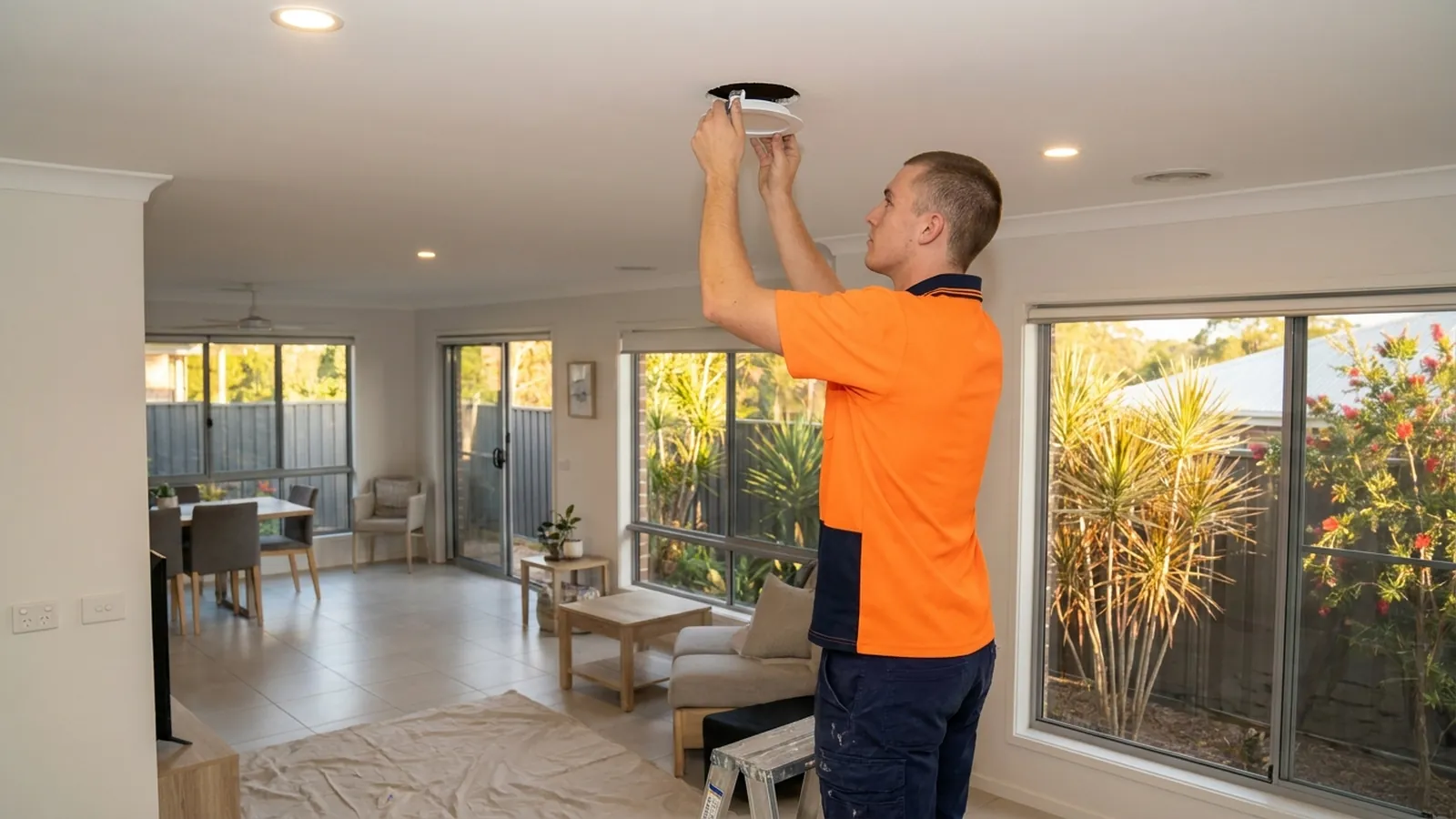
Downlight installs across Brisbane's north side
Downlights sit flush in the ceiling instead of hanging off it. Nearly every home we walk into up here has them somewhere. Kitchen, hallway, living room, bathroom, and in the newer estates, every bedroom as well.
Most of what we get called for falls into two buckets. One is a changeover. Old halogen or dead LED fittings come out, new LEDs go in, same holes, and you've got the room back before lunch. The other is a fresh install, where there's no light in that part of the ceiling yet and we run new cable through the roof space to feed it. Renovations. A dark dining room. A garage that's only ever had one batten holder stuck in the middle.
We do both, for homeowners, for landlords and property managers, and for shops and offices around the north side. Commercial changeovers are common where a tenant has inherited a ceiling full of dead halogens. LEDs draw a fraction of the power of a halogen and they last a lot longer, so the swap is usually an easy call.
The reason there's so much of this work up here is the mix of housing. Plenty of older brick and timber homes around Strathpine and Petrie still have one light in the middle of each room, or they had halogen downlights put in twenty years ago that are well past it. The estate homes in North Lakes and Mango Hill came with builder-grade LED fittings, and after a decade the drivers start letting go one at a time. Closer to the water at Redcliffe, salt air gets into anything sitting in an alfresco ceiling or an eave.
Lighting is one of the few things in a house you use every single day. Get the layout right and you never think about it again. Get it wrong and you're squinting at glare over the dining table, chopping veggies in your own shadow, and looking at holes you can't un-cut.
A word on what downlights won't fix. If a room feels dark because it has one small window and dark paint, more holes in the ceiling isn't always the answer. Sometimes the better job is fewer lights in smarter spots, or a pendant over the table with a few downlights around the edge of the room. We'd rather tell you that than sell you sixteen fittings.
What you're noticing, and what's actually causing it
People usually ring us about one of these.
One light out of the row. Most modern downlights are integrated, which means the LED and the driver are built into the fitting and there's no globe to change. When it dies, the whole fitting gets swapped. Ten years out of one is a fair run.
Flicker, or a buzz on the dimmer. Nine times out of ten it's the dimmer, the driver, or a loose connection. An old rotary dimmer built for halogen loads will make new LEDs flicker and hum, because the load is a fraction of what it expects. Loose connections are the ones worth calling about early. Heat and time work a terminal loose, and a loose terminal runs hot.
A brown or yellow ring around the fitting. That's halogen heat cooking the plasterboard. Halogens are a known cause of ceiling fires, which is most of the reason they've disappeared from new homes.
Lights that cut out, then come back half an hour later. Usually a thermal cut-out doing its job because the fitting is running too hot. Often it's insulation. Batts get pushed over the top of a fitting that isn't rated to be covered, especially in ceilings where the insulation was topped up years after the lights went in.
A whole bank dead at once. That points at the circuit rather than the fittings. Could be the breaker, the safety switch, or a shared connection up in the roof.
A fitting hanging out of the ceiling on its cable. The spring clips have lost their tension, or the hole was cut too big in the first place.
Mismatched colour. Someone has replaced one fitting and the new one throws a different white. Now the kitchen looks odd and you can't unsee it.
Not enough light, or too much of it. Four lights spread evenly across a kitchen ceiling still leaves the bench in shadow if none of them sit over the bench. That's a layout problem, and no amount of brighter fittings fixes it.
Behind all of that, a few local things come up again and again. Storms roll across Moreton Bay every summer and the surges take out LED drivers. Salt air corrodes outdoor fittings and their springs closer to the bay. And we still find DIY work where someone has dropped an LED into an old halogen hole and left the original transformer sitting in the roof space, so the light flickers forever and nobody knows why.
One more thing on older ceilings. Some pre-1990 homes have asbestos sheeting up there. We check before we cut anything, and if we aren't certain what we're looking at, we stop and tell you straight. That's not something to guess at with a hole saw in your hand.
How the job runs, from first call to done
It starts with a phone call. Tell us the room, roughly how many lights you're after, whether it's single or double storey, and whether there's anything in that ceiling now. Photos by text help a lot. For a straight changeover we can usually give you a price over the phone without coming out at all.
Then we lock in a time. You get a day and a time window, and a call if we're running behind. Turning up when we said we would matters, so we try hard not to muck it up.
On the day, drop sheets go down before any tools come out. Gear stays on the sheet.
Next is the layout, and this is the part worth slowing down for. We pencil the positions on the ceiling, then stand back and look at it with you. We work off the room, not a formula. Where the bench is. Which side of the bed you read on. Where you sit to watch telly. Ceiling height, and where the joists fall. Shifting a light 200mm now is easy. Doing it after the hole is cut means patching.
Before anything gets cut we get up into the roof space. We're looking for joists, ducting, water pipes, sarking, what sort of insulation is up there, and how much room there is to crawl. The low pitch roofs in the newer estates are tight and brutally hot, so in summer we book those in early morning. Two-storey homes around Albany Creek are a different story again. There's no roof space above a downstairs ceiling, only the floor of the room above it, so cable has to come from somewhere else. We'll talk that through before you commit to anything.
Power off at the board, tested dead, then the holes get cut. The hole saw runs with a dust catcher on it, so the dust ends up in the catcher instead of your carpet.
Cabling depends on the job. A changeover usually reuses what's already there, and any old halogen transformers get pulled out of the roof rather than left up there to cause trouble later. A new install gets cable run back to an existing lighting circuit, or a new circuit off the switchboard. If your board is old, full, or short on safety switches, you'll hear about it before we start rather than halfway through.
Switches and dimmers get sorted at the same time. If you want dimming, the dimmer has to suit the fittings and the total load on the circuit. We handle that pairing so you don't find out at night that half the room strobes.
Everything we touch gets tested properly: earth, polarity, insulation resistance and the safety switch. Queensland electrical work comes with a Certificate of Testing and Compliance where it's required, and that's part of the job, not an extra.
Then we clean up. Sheets up, floors swept and vacuumed, old fittings and offcuts taken away with us. You shouldn't be able to tell we were there apart from the lights.
Last thing, we walk through it with you. Every light on, the dimmer run through its range, and a quick word on what warranty the fittings carry.
Fittings, gear and the rules we work to
The whole lot goes in to AS/NZS 3000, the Wiring Rules. For recessed lights, the rules that matter day to day are the Australian standards for recessed lights and insulation. A fitting marked IC can be covered by insulation. IC-F means insulation can be butted right up against it and over the top. If a fitting isn't rated for that, it needs clearance, and we keep the batts back to whatever the manufacturer's instructions call for. That one detail is behind a lot of the overheating we get called out to.
Bathrooms and laundries have their own rules. The Wiring Rules set out zones around a shower, bath and basin, and a fitting has to carry a water ingress rating that suits the zone it's going into. An ordinary lounge room downlight over a shower is not on.
Any new lighting circuit goes in with RCD protection. An RCD is the safety switch that cuts the power in a fraction of a second when current heads somewhere it shouldn't, like through a person. Some older homes around Strathpine and Petrie still have lighting with no safety switch on it at all. If we're adding circuits, we'll talk about bringing the board up to scratch while we're there.
On the fittings themselves, we buy from local wholesalers and stick to ranges we've had a good run with. We don't chase the cheapest thing on the shelf. A driver that fails in three years buys you more call-outs, not a saving. If you've already bought your own fittings, we'll install them, and we'll tell you honestly if we reckon they'll let you down.
Two things worth knowing before you choose. Colour temperature is measured in kelvin. Warm white around 3000K reads like the old incandescent light and suits bedrooms, lounges and hallways. Neutral white around 4000K is better in kitchens, laundries, garages and bathrooms where you want to see what you're doing. A lot of fittings now have a small switch on the back so you can pick the colour on site, and some let you dial the output up or down, which is handy when one room needs more punch than the next. The other thing: brightness comes from lumens, not watts. A modern fitting drawing a handful of watts throws more usable light than an old halogen ever did.
Gear-wise, we run hole saws with dust extraction, insulated hand tools and proper test instruments. Not a screwdriver with a light in the handle. In roof spaces we crawl on the joists, stay off ducting, and go carefully around old brittle wiring. The last thing you want out of a lighting job is a foot through the ceiling or a nicked cable nobody finds until summer.
When a downlight problem can't wait
Most downlight work can wait a few days. Some of it can't, and it's worth knowing which is which.
Turn the lighting circuit off at the switchboard and ring us straight away if you've got any of this:
- A burning or hot plastic smell coming from a fitting or the ceiling near it
- Scorch marks or blackening around a downlight
- A fitting hanging down with wires showing, especially anywhere kids can reach
- Water running out of a downlight after a storm, which means a roof leak has found a live fitting
- A lighting circuit that trips the safety switch and won't stay on
That last one matters. Don't keep flicking the safety switch back on. It's tripping for a reason, and it's the only thing standing between a fault and someone copping a shock.
Switching the one circuit off at the board is usually the safe move. You lose the lights in that part of the house for a night. Power points, the fridge and the rest of the place keep running, and nothing gets worse while you wait.
Our hours are Monday to Friday 7am to 5pm, and Saturday mornings 7am to 11am. We don't run a 24 hour service and we won't pretend we do. Jake often answers the phone with a drill still in his hand, and if he can't pick up, leave a message and you'll get a call back.
If you can see flame or smoke in the ceiling, call 000 first. The electrical questions come second.
One more thing while we're up in your roof. If your smoke alarms are over ten years old, or they aren't interconnected photoelectric alarms, we'll let you know what Queensland's rules ask for. Easy to sort while someone is already up there with a torch.
Why people book us
We're rated 5.0 on Google. Two things we hold to: the work gets left clean, and we turn up when we said we would.
Jake Malcolm owns 97 Electrical, holds the licence, and is still on the tools every day. Jake has been running the business a few years now, and the phone is answered by the person doing the work.
We're based in Warner and we keep to a tight patch on purpose. Albany Creek and Eatons Hill, through Warner and Cashmere, up to Kallangur, Narangba and Burpengary, and east to Redcliffe. We don't go out to Caboolture. Staying local means we're not stuck in traffic when you need us, and it means we know the housing stock. Batt-packed estate ceilings. Low pitch roofs you can barely crawl through. Salt air near the water. Tired switchboards in the older suburbs.
The other reason people book us is that nothing gets cut until we've agreed on it. We walk the room, mark the positions, tell you what the roof space allows and what it doesn't, and give you the honest version if the layout you've seen online won't work in your ceiling. Then we do the job, test it, clean up and go.
Ready to get it sorted? Ring us on 0491 105 475 with the room and roughly how many lights you want, and we'll either price it over the phone or book a time to come and have a look. You can also find us at 97electrical.com.au.
Frequently asked questions
What does a downlight install cost?
It depends on how many lights, whether there's already wiring in that ceiling, and how easy the roof space is to get into. Give us a call on 0491 105 475 with the room and a rough number of lights and we'll give you a price over the phone.
Can I swap my old halogen downlights for LEDs?
Yes, and it's one of the most common jobs we do. Old halogens run hot and chew through power. LEDs use a fraction of it and last years longer. In most cases the new fittings drop straight into the existing holes, and we pull any old transformers out of the roof while we're up there.
How many downlights does a room need?
A standard bedroom usually takes four. A living area or kitchen needs more, depending on ceiling height and how the room gets used. We mark the positions on the ceiling and walk through it with you before anything gets cut.
Can I install downlights myself?
No. Downlights are hard-wired, so the work has to be done by a licensed electrician. There's insulation clearance and roof space safety to think about too. Get it wrong and you've got a fire risk sitting in your ceiling.
Do you make a mess cutting the holes?
We use a dust catcher on the hole saw and drop sheets underneath. Floors get swept and vacuumed before we leave, and the old fittings go with us.
Warm white or cool white?
Warm white around 3000K suits bedrooms, lounges and hallways. Neutral white around 4000K works better in kitchens, laundries, garages and bathrooms where you want to see clearly. Plenty of fittings have a switch on the back so you can pick on the day.
Can I have downlights over the shower or bath?
Yes, but the fitting has to be rated for water and suit the zone it's going into under the Wiring Rules. An ordinary lounge room downlight over a shower isn't allowed. We'll sort the right fitting for the spot.
Do you cover my suburb?
We're based in Warner and work from Albany Creek and Eatons Hill through Warner, Cashmere, Strathpine, Petrie and Kallangur, up to North Lakes, Mango Hill, Narangba and Burpengary, and east to Redcliffe. We don't go out to Caboolture. Hours are Monday to Friday 7am to 5pm and Saturday 7am to 11am.