
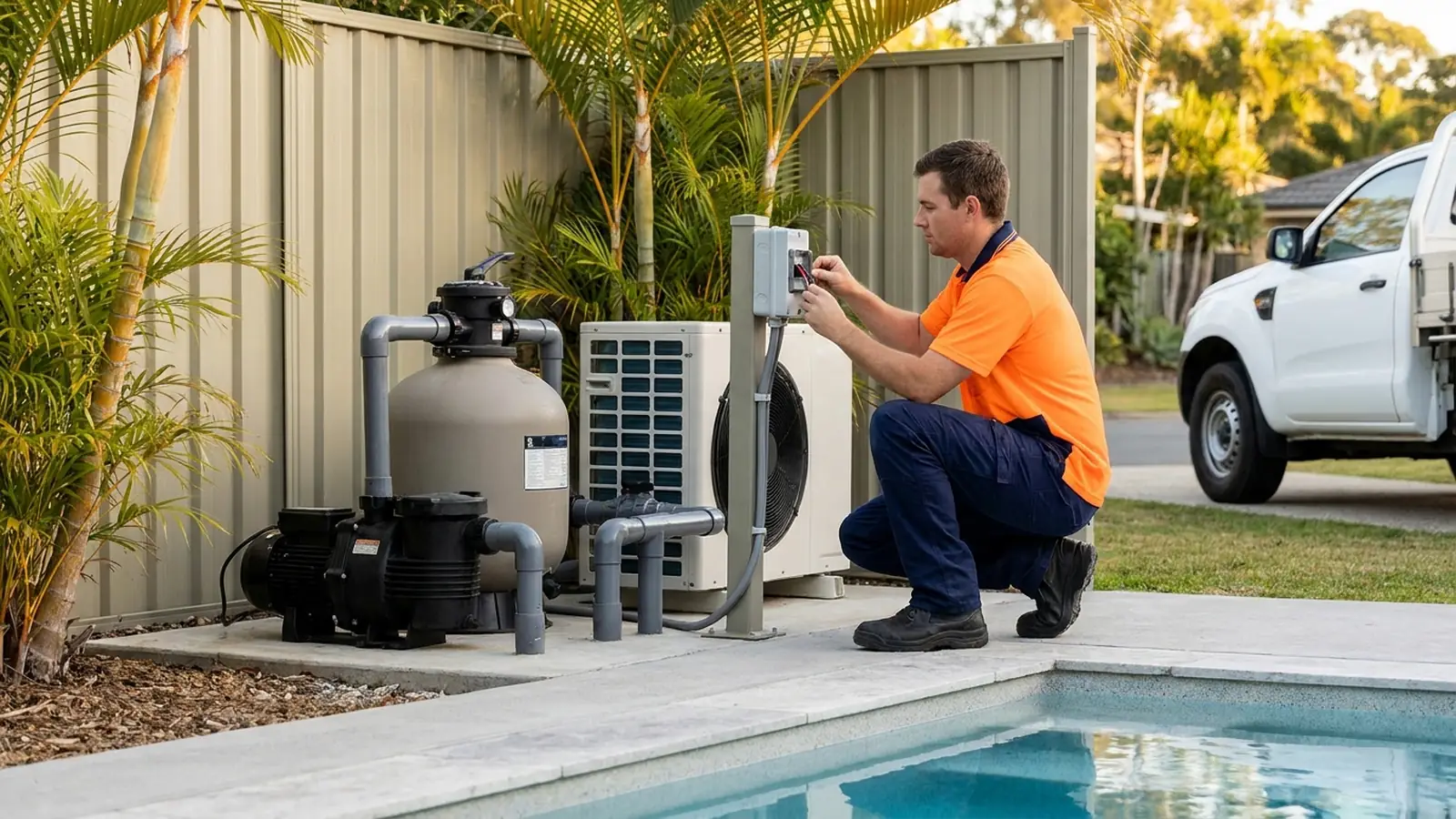
Pool filtration and heat pumps, wired properly
A pool needs power of its own. Proper power, run from the switchboard, on a circuit that belongs to the pool gear and nothing else. Not a lead off the back verandah. Not a double adaptor in the pump shed.
That's the work on this page. 97 Electrical is based in Warner and we wire pool filtration and heat pumps right across Brisbane's north side. Filter pumps, chlorinators and salt cells, pool lights, timers, and the heat pumps people are fitting to stretch the swimming season out to nine or ten months. The electrical side is ours. Water chemistry and plumbing stay with your pool shop or pool builder.
Four types of customer ring us about this.
First, a new pool going in, where the builder needs power at the pad before the pump and filter land. Second, a pump replacement: the old one has packed it in, the new one has a different nameplate, and the supply has to match. Third, heating. A heat pump is the upgrade we get asked about most, and it's the one most likely to need a look at the switchboard first, because it draws a fair bit more than a filter pump. Fourth, the house you've just bought, where the last owner's pool wiring makes you nervous. Extension lead through the laundry window. A power point on the fence gone chalky and cracked. No safety switch anywhere near it.
North side pools give us a bit of everything. The estate homes through North Lakes, Mango Hill and Narangba are mostly newer, so the house wiring is in decent shape, but plenty of those pools went in after the build and the power got run as an afterthought. Older suburbs like Strathpine, Petrie and Kallangur have pools from the eighties and nineties, with conduit that's been baking in the sun for thirty summers. Out at Redcliffe you add salt air, which chews through outdoor fittings faster than anything inland. Different problems, same answer: a proper circuit, the right protection, and gear rated for where it's mounted.
What you notice, and what's actually going on
Hardly anyone rings us about wiring. They ring because something stopped working, or something looks wrong. Here's what comes up most, and the cause sitting underneath it.
The safety switch trips when the pump kicks in. Sometimes it's the pump: moisture in the motor, a worn bearing dragging more current, a capacitor on the way out. Sometimes it's the circuit. If the pool pump shares a circuit with power points inside the house, one damp connection out the back can cut power to half the place. Old pool circuits also start nuisance tripping once the insulation on a buried cable gives up.
The pump won't start, or it hums and stops. Could be the unit. Could be the supply. We test both. Voltage drop is worth a mention, because the pump shed is usually the furthest point from the switchboard. Run undersized cable thirty or forty metres down the side of the house and the pump sees less voltage than it was built for. It runs hot, works harder and dies early.
The outlet by the pool looks rough. Chalky plastic, a lid that won't shut, rust weeping out of the screws, water and spiders inside. That's sun and weather doing what they do. Out at Redcliffe, salt speeds it up. An outdoor outlet that can't keep water out isn't doing the one job it has.
Cracked conduit, or cable stapled to the fence. PVC goes brittle in the sun, and cheap conduit on a west facing wall has a hard life. A lot of the pool wiring we find was never in conduit at all, just cable run along a fence with fencing staples punched through it.
The heat pump keeps knocking the board out. That's usually load, not a fault. Heat pump, plus a couple of split systems, plus an induction cooktop, plus an EV charger. It adds up. Older boards around Strathpine and Petrie are often full, and some are still on ceramic fuses with no safety switches at all. No room for a new circuit, and nothing much protecting the circuits already there.
It all works, but it's costing a fortune. Filter running through the middle of the day on peak tariff, or running twenty hours because nobody knows how to change the setting. A timer on the pump circuit sorts that out in an afternoon.
No safety switch on the pool circuit. This is the big one, and it's the one nobody notices. Water and power in the same backyard with no RCD. An RCD is the safety switch that cuts the power in a fraction of a second when current heads somewhere it shouldn't, including through a person. Any pool circuit should have one. If yours hasn't got one, that's the first thing we'd fix, heat pump or no heat pump.
For the street level version of all this, have a look at our Strathpine and Redcliffe pages.
How the job runs, first call to done
The phone call. Ring 0491 105 475 and tell us what you've got. We'll ask for the make and model off the nameplate, where the pool gear sits in relation to the switchboard, roughly how many metres that is, and whether the run has to cross a path or a garden bed. A photo of the switchboard with the door open helps, and one of the pump area. Most of the time that's enough to give you a price over the phone.
The switchboard check. This matters most with heat pumps. Is there room for another circuit? Are there safety switches on the existing circuits, or is it a ceramic fuse board? We'll tell you straight. If the board needs doing first, we say so and price both jobs so you can decide in your own time. We won't hang a new heat pump off a board that can't carry it.
A time, confirmed. You get a day and a window, and we confirm it. If we're running behind, you get a phone call rather than silence.
Setting up on the day. Boots off inside, drop sheets down where we're working. Before anything gets drilled we walk the run with you and mark where the cable goes and where the outlet or isolator will sit. Easier to move a mark than a hole.
Running the new circuit. A dedicated circuit from the switchboard out to the pool gear. Conduit where it's exposed, buried at the depth the wiring rules call for where it goes underground, clipped straight and level the whole way. Through the roof space or under the house when that's the tidier path.
Protection and switching. New breaker and RCD at the board, labelled so the next person knows what's what. A weatherproof outlet or isolating switch at the pool end, mounted clear of the splash zone and close enough to the unit that it can be shut down without a walk to the board.
Timer set to your hours. Tell us when you want the filter running. Overnight, early morning, off peak, whatever suits your tariff and your neighbours. We set it before we leave and show you how to change it.
Test, connect, explain. We test the circuit, connect the unit, run it up, check what it's actually drawing and confirm the safety switch trips the way it should. Then a quick walk around: this is your isolator, this is the breaker at the board, this is how the timer works.
Clean up. Offcuts, screws and drill dust leave with us. Floors swept, board cover back on, gear off your lawn.
Paperwork. You get a certificate of testing and compliance for the new work, and the invoice. Handy to keep with the house file, especially if you sell later.
Gear and standards
Everything we install sits under AS/NZS 3000, the wiring rules. Pools get their own section of it. Section 6 covers damp situations, including swimming pools and spas, and it sets out zones around the water, what equipment is allowed in each zone, and how it has to be protected. That's why an outlet sometimes can't go exactly where you'd like it. The rules decide, not us.
The practical version:
- A safety switch on the circuit. 30 mA RCD protection, every time, on anything that runs outside near water.
- Outdoor rated enclosures. IP rated gear with seals that seal and a lid that closes. Near the water at Redcliffe we pay extra attention to the fixings, because salt air finds cheap screws first.
- The right cable size for the distance. We size for the load and the length of the run so voltage drop stays inside limits. A long haul to a back corner pump shed gets bigger cable, not a longer lead.
- Conduit and burial depth. Heavy duty conduit where the sun or a whipper snipper can reach it, and underground runs buried to the depth the rules require, with mechanical protection so a future garden bed doesn't find your cable with a shovel.
- Isolation at the unit. A switch you can see and reach, so the pump or heat pump can be made safe on the spot.
- A labelled switchboard. Pool pump and heat pump named on the board, not guessed at.
- Compliance paperwork. A certificate of testing and compliance, as Queensland's electrical safety laws require. Jake is a licensed electrician and every circuit gets tested before we call it done.
On the equipment itself: most customers buy the pump or heat pump through their pool shop and have us do the electrical side. That works well, and we're happy to talk to the shop about supply requirements off the nameplate. If you'd rather we handled the unit as well, give us a ring and we'll talk through what suits the size of your pool. The outlets, isolators and timers we fit are trade quality rather than the cheapest thing on the shelf, because pool gear lives outdoors in Queensland weather for ten years or more.
One more thing on heat pumps. Check the supply the unit needs before you buy it. Some want a dedicated circuit of a particular size, some are single phase, and the bigger ones can want three phase. Send us the model number first and we'll tell you what the house needs to have. Far cheaper than finding out after delivery.
When it can't wait
We're not a 24 hour operation and we won't pretend to be. We work Monday to Friday, 7am to 5pm, and Saturday mornings from 7am to 11am. Ring 0491 105 475 in those hours and you'll get Jake or a call back.
Some pool faults shouldn't sit around, though. A burnt smell near the pump, buzzing from an outlet, water sitting inside a fitting, switchgear that's warm to touch, or a safety switch that trips the instant you reset it. All of those mean something is wrong now, not later.
Do this: switch that circuit off at the board and leave it off. Keep everyone out of the water if a pool light or a fitting near the water is involved. Don't open the pump box up to have a look. Then call us during business hours and tell us what you saw or smelt, and we'll tell you honestly when we can be there.
Storms are the other one. Summer storms roll across Moreton Bay and dump water where it isn't wanted. If your pump box or outdoor outlet has been flooded, leave the circuit off until someone's checked it. Switching a flooded pump straight back on is a good way to lose the motor along with the wiring.
Plenty of our days run through Albany Creek and Warner streets, so tell us what's going on and we'll fit you in where we can. A green pool two days before a party isn't an electrical emergency, but we understand it feels like one.
Why people book us for this
97 Electrical is Jake's business, going on three years now, run out of Warner. We're rated 5.0 on Google, and these are the things we care about.
We turn up when we say we will. If a job before yours blows out, you get a call.
The work gets left tidy. Cable clipped straight, conduit lined up, no offcuts in the garden, floors swept before we go. It sounds like a small thing until you've had someone leave a mess in your backyard.
We explain the job in plain English. What the circuit does, why the safety switch is there, what the board can and can't carry. No jargon dropped on you and no pressure to buy anything you don't need.
And we're local. Warner base, a tight patch from Albany Creek across to Narangba and Burpengary, east to Redcliffe. We know the estate homes through North Lakes and Mango Hill, and we know the older boards in Strathpine, Petrie and Kallangur. That local knowledge saves time on the day, which keeps your bill down.
Pool pump on its last legs, or a heat pump sitting in the garage waiting to go in? Grab the model number and a rough idea of how far the gear sits from your switchboard, then ring Jake on 0491 105 475. We'll price it over the phone and sort out a time.
Frequently asked questions
What does a pool heat pump install cost?
It comes down to the unit, how far it sits from the switchboard, and whether your board has room for another circuit. Ring Jake on 0491 105 475 with the model and a rough distance and we'll give you a price over the phone.
Can my switchboard handle a pool heat pump?
Often yes, not always. Older boards around Strathpine, Petrie and Kallangur can be full, or still running ceramic fuses with no safety switches. We check the board first and tell you straight if it needs upgrading before the heat pump goes in. If it does, we price both jobs so you can decide.
Does a pool pump need its own safety switch?
Yes. Anything running outdoors near water needs an RCD on the circuit. That's the safety switch that cuts the power in a fraction of a second if there's a fault. We fit one as part of the job, on a dedicated circuit rather than sharing with power points inside the house.
Can you fit a timer so the filter runs overnight?
We can. A timer on the pump circuit lets you set the run hours to suit your tariff and keep the noise down for the neighbours. Tell us the hours you want and we'll set it up and show you how to change it before we leave.
Do you supply the pool heat pump or do I buy it?
Either way works. Most people buy the unit through their pool shop and we do the electrical side. If you'd rather we handled supply, call 0491 105 475 and we'll talk through what suits your pool size.
I'm just swapping an old pump for a new one. Do I still need new wiring?
Sometimes the existing supply is fine. Sometimes the new pump draws more, or the old cable and outlet are past it, or there's no safety switch on the circuit. Send us the nameplate details and a photo of the current setup and we'll tell you what it needs.
Do I get paperwork when the job's done?
Yes. You get a certificate of testing and compliance for the new electrical work, as Queensland law requires, plus the invoice. Worth keeping with the house file if you ever sell.
Are you around on weekends or after hours?
We work Monday to Friday 7am to 5pm, and Saturday mornings 7am to 11am. We're not open around the clock. If something urgent happens outside those hours, like a burnt smell or water inside a fitting, switch that circuit off at the board and ring 0491 105 475 when we open.