
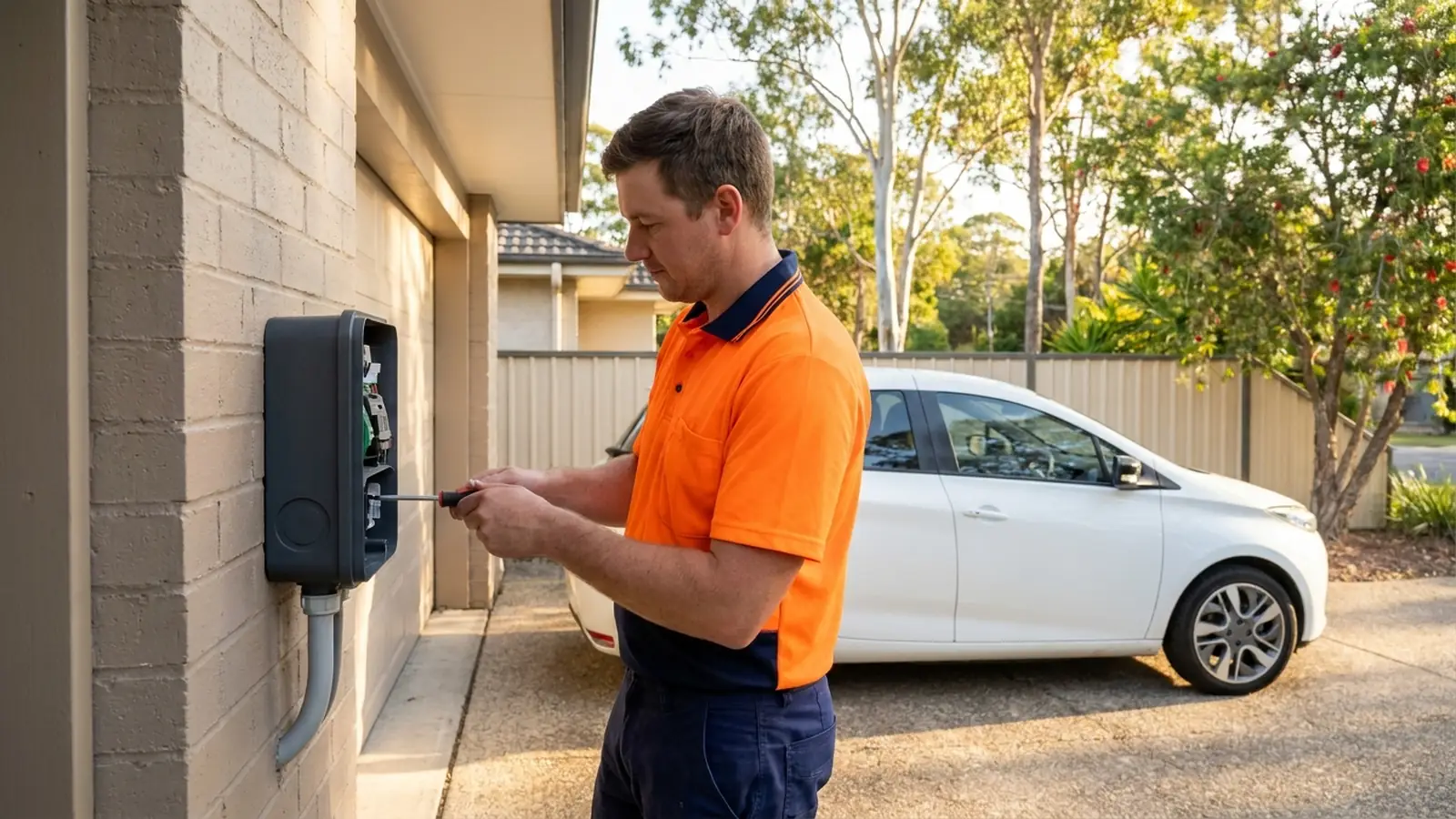
EV chargers, wired properly and left tidy
A home EV charger is a fixed unit on the wall with its own circuit back to your switchboard. You plug in when you get home, it charges overnight, and you wake up full. No lead across the floor. No wondering whether the power point can take it.
We install home and small business EV chargers across Brisbane's north side, from Albany Creek and Warner out to Narangba and Burpengary, and east to Redcliffe. Most of what we fit is a single phase wall unit around 7kW, mounted in the garage or under the carport, with a dedicated circuit and safety switch added at the board. A few places have three phase and can run a bigger unit. Most homes don't, and that's usually fine. Seven kilowatts overnight puts back far more range than the average north side commute burns in a day.
The work suits anyone who's just picked up an EV or a plug-in hybrid, anyone sick of charging at 10 amps off a power point, and any small business with a van or ute that has to be full by six in the morning. We also get builders and owners mid-reno ringing about a charger circuit before the wall sheets go on. That's the easiest time to do it. We'll run the cable and leave it capped and labelled until the charger turns up.
Homes up here fall into two rough camps. The newer estate homes around North Lakes, Mango Hill and Narangba are usually simple: modern board, safety switches already in, garage a few metres from the meter box. The older stock is a different story. Boards in Petrie and Strathpine were never designed for a car pulling 32 amps for six hours straight. Some cope. Plenty need sorting first, and we'd rather tell you that before you buy anything.
What people notice before they call
Most calls start the same way. The car came with a portable lead, the dealer said it'd do for now, and now it won't. Charging off a standard 10 amp power point is slow. A decent top-up can take a day and a half. The plug gets warm, and sometimes the socket discolours around the pins. That's heat. A power point that's been in the wall since the early 80s was built for a kettle for four minutes, not a car for fourteen hours. Portable leads are handy for a one-off at the in-laws. For everyday charging at home they fall short.
The next most common call is tripping. You plug in, the car starts drawing current, and a few minutes later the safety switch drops out and takes half the house with it. Usually that means the lead is sharing a circuit with the fridge, the freezer and the garage lights, or there's a small existing fault that the extra load has finally exposed. A safety switch tripping means something. It's doing its job and pointing at a problem on that circuit.
Then there's the board itself. We still open plenty of ceramic fuse boards and old rewireable boards around Strathpine, Kallangur and Petrie. Signs it's due: rewireable fuses instead of circuit breakers, no safety switches at all, no spare ways left, or a mix of add-ons from three different decades. An EV charger needs its own circuit and its own RCD, which is a safety switch that cuts the power in a fraction of a second if current starts going where it shouldn't. If there's nowhere to put that, the board comes first. Some older boards also have an asbestos backing sheet behind the gear. If we find one, we don't drill it or cut it. We handle it the right way and explain what that means for the job.
Distance is the other thing people don't think about. If the meter box is on the street side and the garage is out the back, that's a long cable run, sometimes through a roof space and down a wall cavity. Detached garages and sheds need a submain, and often a trench. None of it is hard. It just changes the time and the materials, which is why we look before we quote.
Down at Redcliffe and around the bay, salt air gets into everything. We see corroded meter boxes, rusted screws and pitted enclosures within a few streets of the water. Outdoor and carport installs there need a properly rated weatherproof enclosure, stainless fixings, and a spot that isn't copping driving rain off the bay. Storms are the other local factor. A summer front across Moreton Bay brings surges and a lot of water sideways, so we think about where the unit sits and whether surge protection at the board is worth adding while we're in there.
Solar comes up constantly. Lots of homes up here have panels and want the car charging off them in the middle of the day. That's doable, but it needs a bit of thought: either a charger that can read what the house is exporting, or a simple schedule that lines up with the sun. We'll talk through what your setup can actually do rather than promise magic.
How the job runs, first call to done
It starts with a phone call. Ring 0491 105 475 and we'll ask a handful of questions. What car, what charger if you've already bought one, where you park, where the meter box is, and roughly how old the house is. A couple of photos help more than anything: one of the open switchboard, one of the wall where you want the charger, one of the meter box. From that we can usually tell you whether it's a straight install or whether the board needs attention first.
For anything beyond a simple garage job, we come out and look properly. Main switch rating, what's already on the board, spare ways, the cable route, and where the unit should sit so the lead reaches the car's port without stretching across the driveway. We measure the run. We check what's coming into the house. Then you get a quote with the charger, the circuit, the cable run and any board work listed separately, so you can see what's what.
Once you're happy we book a day and a time window, and we turn up in it. If something shifts, you get a call, not silence. That part matters more to most people than anything technical we do.
On the day, drop sheets go down first. We isolate the power, then run the cable from the board to the charger position, clipped and saddled properly, in conduit where it's exposed. Cable is sized for the load and the length of the run, not just whatever's on the van. Holes through walls get made good. At the board we fit a dedicated circuit breaker and the right type of RCD, label the new circuit, and leave the inside of the board neat rather than a bird's nest.
The charger goes up on solid fixings, level, at a height where the plug is easy to reach and the lead hangs without kinking. Terminations are torqued to the manufacturer's figures and checked again before anything goes live.
Then we test. Earth continuity, insulation resistance, polarity and RCD trip times, all recorded. After that we energise and run the charger with your car actually plugged in, so you see it pull current instead of taking our word for it.
Last bit is the walk-through. We show you how to start and stop a charge, what the lights mean, how to set a schedule if you're on a time of use tariff, and we get the app paired on your phone before we leave. Five minutes there saves you a phone call at 9pm on a Sunday.
You get your certificate of testing and compliance for the electrical work, plus the charger's manual and warranty details. Then we pack up, take the offcuts and packaging with us, and sweep the floor. The garage looks like we were never there, apart from the new charger on the wall.
Gear, cable and the standards behind it
We're not tied to one brand. Some people buy the charger through the dealer with the car, others want a recommendation. Either way works. Tell us what you drive, where you park, and whether you want a tethered unit with the lead attached or a socket you plug your own lead into, and we'll talk it through. Tethered is more convenient day to day. A socket unit is tidier on the wall and easier to live with if you change cars.
What we care about is that the unit is sold for the Australian market, has local support and a warranty that means something, and meets the equipment standards for EV charging gear (the AS/NZS IEC 61851 series). Grey import units with nobody behind them aren't worth the saving.
The install side follows AS/NZS 3000, the Wiring Rules, which has a section specifically for electric vehicle charging. In plain terms: the charger gets its own circuit, the cable is sized for a load that runs for hours rather than minutes, it's derated where it passes through insulation or a hot roof space, voltage drop is kept in check on long runs, and the circuit has RCD protection. EV chargers need the right kind of safety switch, because a fault on the car side can involve a small amount of DC that a basic RCD won't see. So it's a Type A RCD on the circuit paired with a charger that has DC fault detection built in, or whatever equivalent the manufacturer specifies. Testing follows AS/NZS 3017, the test methods that sit behind the Wiring Rules, and all of it is done under Queensland's electrical safety laws. That's where your certificate comes from.
Load is the other half of the equation. A charger running at 32 amps for hours sits alongside your hot water, aircon, oven and pool pump. On a single phase supply that adds up quickly. We look at the main switch, the service cable and what else is running of an evening, then work out whether the supply handles it. Where it's tight there are options: a lower charge current, a schedule that keeps the car off peak, or dynamic load management, where a sensor on the main reads the whole house and backs the charger off when the oven and the aircon are going. Larger loads can also need paperwork with Energex before they're energised, and where that applies we sort it.
For outdoor and carport installs, especially near the water, everything gets the right IP rating and corrosion resistant fixings, and conduit is UV rated. Cable runs in straight lines, clipped, not draped.
If the board needs upgrading first, that's a separate line on the quote and a separate conversation. We fit a new board with circuit breakers and safety switches across the circuits, label the lot, and you end up with a safer house rather than just a car that charges. A fair few of the EV jobs we do around Albany Creek and Eatons Hill end up being a board upgrade and a charger on the same day.
When it's urgent
We work Monday to Friday, 7am to 5pm, and Saturday mornings, 7am to 11am. Ring inside those hours and you'll get Jake or a call back. Outside them, leave a message and we'll come back to you first thing.
What counts as urgent with EV charging: a burning smell or scorch marks at a socket or inside the board, a charger that keeps knocking the main switch out, water sitting in a charger enclosure after a storm, or damage from a reversing mishap in the garage. If you can smell burning or see scorching, switch that circuit off at the board, or the main switch if you're not sure which one it is, and stop using it. Don't plug back in to test it. Then ring 0491 105 475 and tell us what you saw and smelled.
If the whole street is out after a storm, that's a network fault rather than your charger, so ring Energex on 13 19 62. Power on next door and off at your place is one for us.
Most urgent EV calls come back to a tripping circuit. Often the first job is making it safe, even when the full fix needs a part ordered in. Making it safe might mean isolating and locking off the charger circuit so the rest of the house runs normally while you wait. You shouldn't be without lights and hot water because the car charger's crook. When you ring, we'll give you the next real slot instead of stringing you along.
Why people book us for this work
97 Electrical is Jake's business, based in Warner. About three years under our own name now, doing residential and commercial work across a tight patch of the north side. We cover Albany Creek through to Narangba and Burpengary, and east to Redcliffe. We don't go to Caboolture. Keeping the area small is how we manage to turn up when we say we will.
We're rated 5.0 on Google. What we aim for is simple: turn up on time, explain what we're doing, and leave the place clean. Tidy cable runs, holes made good, packaging in the van, floor swept.
All wiring, switchboard and charger work is done by a licensed electrician, tested before it goes live, and certificated. We'll also tell you straight when the answer isn't the one you wanted. If your board can't take a charger without an upgrade, you'll hear it on the first call, not after we've started. If the charger you've been offered doesn't suit how you park, we'll say that too.
We're happy to work alongside your builder or your car dealer, and we can rough in a charger circuit during a reno and come back later to fit the unit. In the newer estates around Mango Hill and North Lakes we're often in and out in half a day.
Got a car on order and want the charger ready before it lands? Ring Jake on 0491 105 475 with your address and the charger you're looking at, or send photos of your switchboard through 97electrical.com.au and we'll tell you where you stand.
Frequently asked questions
Can my switchboard handle an EV charger?
Sometimes yes, sometimes no. A charger pulls a fair bit of current for hours at a time, so it needs its own circuit and its own safety switch (an RCD, which cuts power fast if there's a fault). We check the board, the main switch and what else runs in the evening before we commit to anything. Plenty of older homes around Petrie, Strathpine and Kallangur need the board sorted first, and we'll tell you that up front.
Do I need a licensed electrician to install an EV charger?
Yes. Hard-wiring a charger and working inside a switchboard is licensed electrical work. Plugging a portable lead into an existing power point isn't a fix either, because those points weren't built for hours of high draw. Get a licensed electrician to do it properly and you get a certificate for the work at the end.
How long does an EV charger install take?
A straightforward garage install is usually a half day. It stretches out if the cable run is long, the meter box sits on the far side of the house, the garage is detached, or the board needs upgrading at the same time. We'll give you a realistic time frame when we book it in.
What does an EV charger installation cost?
It depends on the charger, the length of the cable run and whether the switchboard needs work first. Ring us on 0491 105 475 with your address and the charger you've bought and we'll sort out a quote. We cover Albany Creek through to Narangba and Burpengary, and east to Redcliffe.
Do you supply the charger or do I buy it?
Either way works. Some people buy through the car dealer with the car, others want a recommendation. Tell us what you drive, where you park, and whether you want a tethered unit with the lead attached or a socket you plug your own lead into, and we'll talk through what suits.
Can I just keep using the portable lead that came with the car?
For a one-off away from home, fine. For every night at home, no. A standard 10 amp power point was designed for short bursts, not fourteen hours of steady draw, and that's why the plug gets warm and the socket discolours. If yours is warm or marked, stop using it and give us a call.
Do I need three phase power or a 22kW charger?
Most north side homes are single phase, and a 7kW charger overnight puts back more range than the average daily drive uses. Three phase gives you faster charging, but if the house isn't already three phase the cost of getting it there rarely stacks up for a car. We'll look at your supply and tell you what's worth doing.
Can I charge the car off my solar?
Often yes. It needs either a charger that can read what your house is exporting, or a simple schedule set to the middle of the day. We'll look at your inverter and metering setup and tell you what it can actually do before you buy a charger for that reason.