
What ducted aircon needs from an electrician
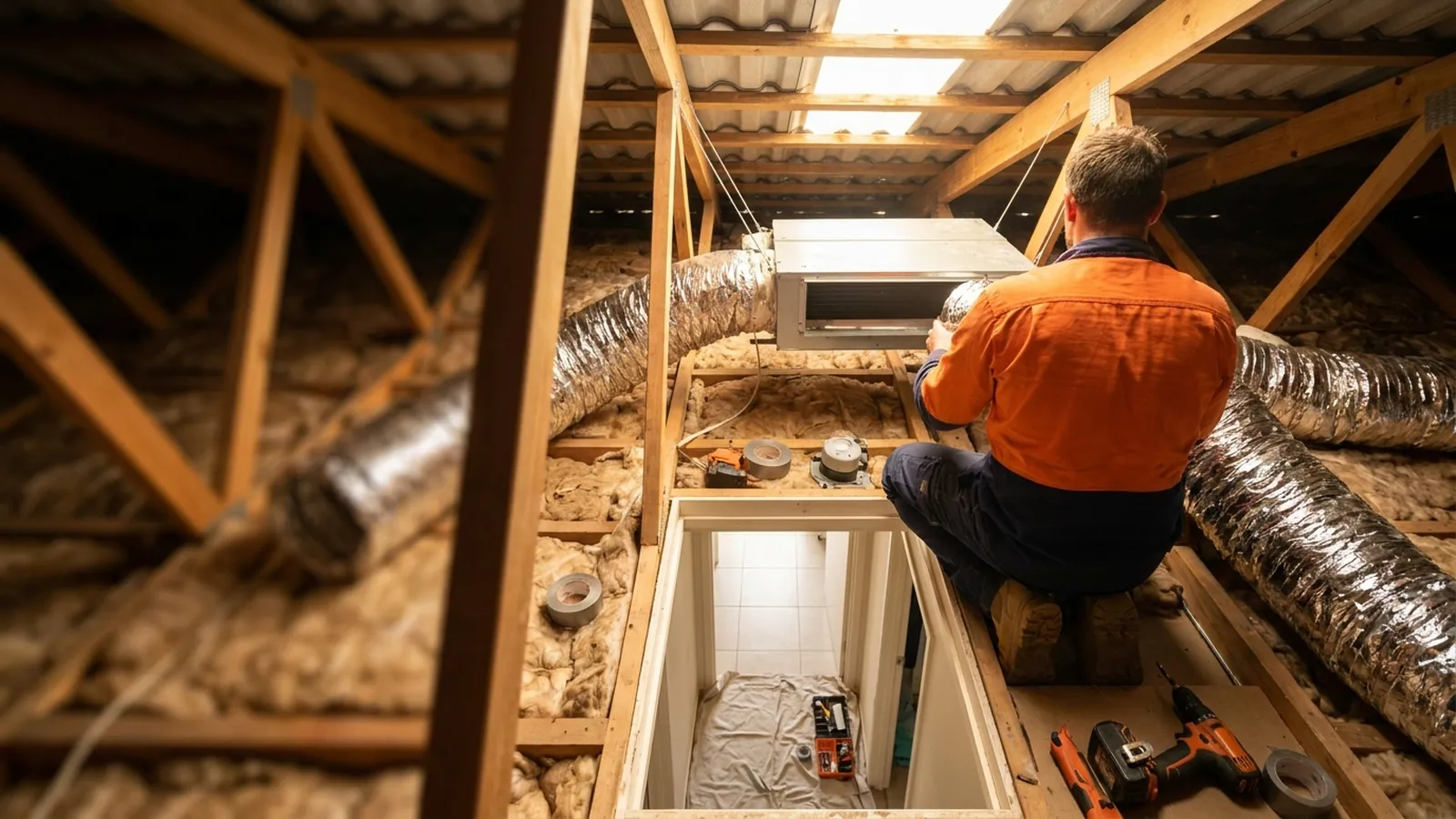
Ducted air conditioning runs off one indoor fan coil sitting up in your roof space. Insulated ducts run from it to a vent in every room, and the condenser sits outside on a slab or a bracket. You drive it from a wall controller. Most systems going in now are zoned, so motorised dampers open and shut the ducts room by room.
Behind all of that sits a fair bit of electrical work, and anything that carries power is our side.
That means a dedicated circuit run from the switchboard and sized for the unit you've bought. An isolating switch outside, where you can see it from the condenser. Power and control wiring up to the fan coil in the roof. A controller cable down the wall cavity. Wiring for the zone board and the damper motors if the system is zoned. Sometimes a bigger switchboard, or a new sub main, before any of that can happen.
It's a heavier job than most people expect. A ducted system sized for a four bedroom house can pull more current than the rest of the house put together on a 38 degree afternoon. It doesn't share a circuit with your powerpoints or the oven. It gets its own run, protected to suit the unit, with a safety switch on it.
Most of our ducted work is homes. Owners with three or four splits bolted on over the years who want one system doing the lot. Renovations and extensions. New builds where the slab has just gone down. Landlords fitting out a rental properly. We do small commercial too: offices, a shop fitout, consulting rooms, where the unit is bigger again and the board is usually three phase.
North side houses cop it in summer. Humid nights that never drop below 24, big west facing glass in the newer estates, and storms coming across Moreton Bay that knock the power around. Out through North Lakes and Mango Hill the homes are newer, the boards are generally modern, and there's usually room for another circuit. Closer in around Strathpine and Petrie it's a different story. Plenty of those boards went in decades ago and were never sized for a ducted system.
We'll tell you which one you've got before you lock in a date.
What people notice before they ring us
Ducted calls tend to come in three ways. The system isn't in yet and the aircon supplier has said the switchboard needs looking at. Or the system is in and it keeps dropping out. Or the house is just too hot and the splits have given up.
Here's what's usually behind each of those.
A breaker that trips the second the compressor kicks in is telling you the circuit is undersized, shared with something else, or fitted with the wrong type of breaker. Compressors pull a big hit of current for a second or two on start up. A breaker picked for a lighting circuit won't wear that, and it shouldn't have to.
A safety switch that trips on wet mornings is often moisture getting into the outdoor isolator, or a tired connection somewhere in the run. Down at Redcliffe and along the bay, salt air chews through cheap outdoor gear fast. We pull covers off and find green terminals, rusted glands and water sitting in an enclosure that was never rated for where it was mounted.
A controller that goes blank, or a system that forgets its zones, is nearly always a control wiring fault. A loose terminal at the fan coil. A cable pinched under a batt of insulation. Control cable run tight alongside a power cable, so it picks up interference it should never be near.
Lights dimming when the aircon starts is voltage drop. Long cable run, cable too thin for the distance, or a main supply that's already stretched. On the bigger blocks around Kallangur and Narangba, the run from the pole to the board can be long before anything gets near the aircon.
Then there's the board itself, and that's the one that holds jobs up most. Ceramic fuses. No safety switches. Or every spare way already taken by the solar, the hot water and the pool pump, so there's physically nowhere to land a new circuit. We'd much rather find that three weeks out than on install morning with the installers standing in your driveway.
Behind all of it is housing stock and weather. Homes built through the 70s and 80s around Strathpine, Petrie and Kallangur were wired for a fridge, a kettle and a couple of lights. Brick and tile places through Albany Creek and Eatons Hill from the 80s and 90s are better, though plenty have had solar added since and the board is full. Queensland roof spaces push well past 50 degrees in January, which ages cable insulation and works terminals loose over time. Add blown in ceiling insulation sitting over old cable, the odd possum, and a few years of summer storms. You end up with faults that only show themselves when you put a real load on the system.
How we run the job
First is a phone call. Ring us on 0491 105 475 and tell us the basics: how many bedrooms, single or double storey, what unit the aircon supplier has quoted, and roughly where the outdoor unit is going. Then send a photo of the switchboard with the cover on, and a second one from a couple of steps back. That takes two minutes. It tells us a lot before anyone drives anywhere.
Next we come out and look. The board, the main switch, the incoming supply, the meter, the roof access, and the path the cable has to take from board to fan coil to isolator. If the roof is low pitch or the manhole is in the back of a robe, we want to know that now, not on install day. We'll also check what the aircon installer is planning so the two jobs don't clash.
Then you get a quote in writing, in plain English, with any switchboard work priced separately so you can see it. If we think the board is fine, we'll say so. We don't sell upgrades nobody needs, and we won't guess a number over the phone without seeing the job.
Once you're happy, we book it in and ring the mob doing the ducting. Most ducted jobs run in two visits from our side. First fix goes in while the ducts are being pulled, so the circuit, the isolator run and the controller cable are all in place. Second visit is the connection, once the unit is mounted and gassed.
If the switchboard needs work, that happens first, usually as its own morning. New board, RCBOs on the circuits, everything labelled so the next person can read it. Power is off for part of it. We'll tell you how long before the day, not on the day.
Install day starts when we said it would. Drop sheets go down before anything else, under the board and under the manhole. Cable gets run and clipped properly through the roof, kept clear of where insulation will end up sitting on it, and protected where it crosses timber. The isolator goes on the wall near the condenser where you can actually reach it. Fan coil supply and control wiring is terminated to the manufacturer's diagram, not to a guess.
Then we test it. Insulation resistance, earth continuity, polarity and RCD trip times, all recorded. We fire the system up with the installer, run every zone, and make sure the controller does what the screen says it's doing.
Last part is the bit people remember. We vacuum up, pick up every offcut and screw, wipe down the ceiling around the manhole and take our rubbish with us. You get a walk through of the new circuit and the isolator, your Certificate of Testing and Compliance, and our number if anything plays up later.
Gear, cable and the rules we work to
We install to AS/NZS 3000, the Wiring Rules, and size cable using AS/NZS 3008.1.1. That second one matters more than people think on a ducted job. The cable has to handle running current, start up current and voltage drop over the distance, and it has to be derated for a roof space that hits 50 plus degrees with insulation pressed against it. A cable that looks fine on paper at 25 degrees can be marginal in a Queensland ceiling in February. We size for the hot day, not the mild one.
Breaker size comes off the manufacturer's data plate for your unit, not off a rule of thumb. Every new circuit we run in a house gets a safety switch, which is an RCD: the device that cuts the power in a fraction of a second if current starts leaking where it shouldn't. That's what the current Wiring Rules ask for on new final subcircuits in a home. We fit RCBOs where we can, so one fault doesn't drop half the house.
The outdoor isolator is weatherproof and UV stable, mounted where you can see it from the condenser. That's what the rules ask for, and it's what any service tech will thank you for at the first pump down. Near the water at Redcliffe we use stainless fixings and seal the glands properly. Standard hardware doesn't last in salt air.
We work with whatever brand of system your aircon supplier is putting in. Our job is to make the power side suit that unit, wire the fan coil and controller to the manufacturer's diagram, and leave the installer a clean connection point.
At the board, every circuit gets labelled and the schedule written up, so the next sparky isn't guessing. If we replace a board you get a main switch, RCBOs, and a layout with the cables dressed and the cover sitting flush. We take photos before and after, because that's how we'd want it shown to us.
When the work's done we test to the methods in AS/NZS 3017 and issue the Certificate of Testing and Compliance that Queensland electrical law requires. Keep it with your house paperwork. If you sell, or if there's ever an insurance question, that's the document showing the work was done by a licensed electrician and tested.
When it can't wait
We're not open around the clock and we won't pretend to be. Hours are Monday to Friday 7am to 5pm, and Saturday mornings 7am to 11am. What we will do is answer the phone or ring you back, and tell you straight when we can get there.
Aircon faults in a heatwave get priority where we can shuffle the day, particularly for older folks or a house with a newborn in it.
If your ducted system has dropped out, here's what helps before we get there. Reset the breaker once. If it trips again, leave it off and ring us. Holding a breaker in, or resetting it over and over, is how a small fault turns into a burnt board.
If you can smell burning, hear buzzing at the switchboard, or see scorching or discolouration around a breaker, switch the main switch off and call us before you touch anything else. Same if the outdoor isolator has been underwater after a storm. Don't open it. Don't try to dry it out.
And if the safety switch drops the whole house every time the aircon starts, that's a fault, and the switch is doing its job. Leave the aircon circuit off, use the rest of the house, and we'll come and find it.
Why people call us
97 Electrical is Jake's business, run out of Warner. We've been going about three years and we work a tight patch on the north side: Albany Creek, Eatons Hill, Cashmere, Warner, Strathpine, Petrie, Kallangur, North Lakes, Mango Hill, Narangba, Burpengary and across to Redcliffe. We don't run up to Caboolture. Keeping the area tight is how we turn up when we said we would.
We're rated 5.0 on Google. We aim for a tidy finish, and we show up on time and return calls.
Jake's a licensed electrician and still on the tools every day.
On ducted specifically: we look at the switchboard before we price the circuit, not after. We coordinate with your aircon installer so both halves of the job land on the same day. And we'll tell you honestly if your board is fine, because plenty of them are.
Ring us on 0491 105 475 to talk through your ducted install, or have a look at 97electrical.com.au.
Frequently asked questions
What does the electrical side of a ducted aircon install cost?
It depends on the size of the home, how many zones you're running, roof access, cable distance and whether the switchboard needs work first. We won't throw a number online and hope. Give us a ring on 0491 105 475, tell us about your place, and we'll come and quote it properly in writing.
Will my switchboard handle a ducted system?
Often it needs a look. Ducted draws a lot more than a single split, and plenty of older boards around Petrie and Kallangur are already full or still running ceramic fuses. We check the board, the main supply and the safety switches before we commit to an install date, so nobody finds out on the morning.
What electrical work do you do on a ducted install?
The dedicated circuit from the board, the isolator at the outdoor unit, and the supply and control wiring for the fan coil and controller. We coordinate with the installer doing the ducting so the two halves line up on the day.
How long does the electrical side take?
Usually a day for most homes, spread across a first fix and a connection visit. Two days if the switchboard is being upgraded at the same time. We'll give you a timeframe when we quote, and we'll ring you if anything shifts.
Does the ducted circuit need a safety switch?
Yes. New final subcircuits in a home need RCD protection under the current Wiring Rules, and that includes the one feeding your aircon. An RCD is the safety switch that cuts power in a fraction of a second if current leaks somewhere it shouldn't. We fit RCBOs where the board allows it, so one fault doesn't take out half the house.
I've already got solar and my board looks full. Can I still add ducted?
Usually, yes, but the board needs assessing first. Solar, hot water and a pool pump can eat every spare way. Sometimes we can rearrange the board, sometimes it's a new one. We'll look at it, tell you which it is, and price it separately from the aircon circuit.
What paperwork do I get when the job's done?
A Certificate of Testing and Compliance for the electrical work, which is what Queensland requires. It records that the circuit was tested by a licensed electrician. Keep it with your house paperwork for insurance or a future sale.
Which suburbs do you cover for ducted installs?
We're based in Warner and work the north side: Albany Creek, Eatons Hill, Cashmere, Warner, Strathpine, Petrie, Kallangur, North Lakes, Mango Hill, Narangba, Burpengary and out to Redcliffe. We don't go up to Caboolture. Not sure if you're in range? Ask us on 0491 105 475.