
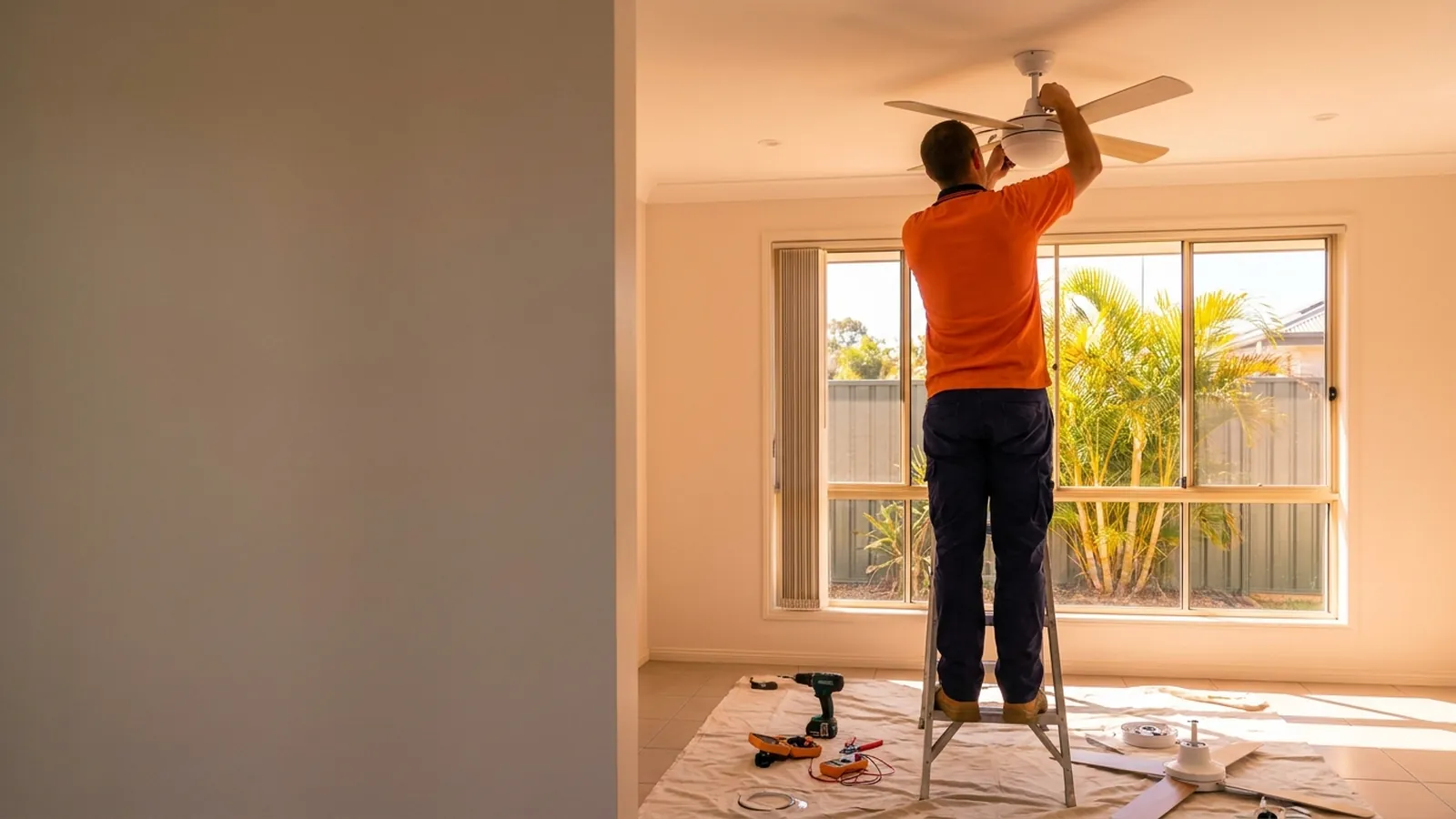
Ceiling fan installs across Brisbane's north side
Most houses up here have one room that cooks. A west facing bedroom, a lounge sitting under a dark roof, or an alfresco slab that holds the heat until well after dark. A ceiling fan takes the edge off all of that, and it uses a small slice of the power a split system draws. It's the first thing people ask us about once the weather turns in September.
We install ceiling fans right across the north side, from Albany Creek up through Narangba and Burpengary, east to Redcliffe. Three jobs cover nearly all of it. Fitting a new fan where there's already a fan or a light point. Running fresh wiring into a room that's never had one. Taking down a wobbly old unit and hanging something that runs quiet. We're based in Warner, so if you're around Albany Creek, we're only up the road.
Who books them in? Homeowners getting ahead of summer. Parents setting up a nursery who want air moving without a draught straight onto the cot. Landlords and property managers clearing a tenant request before the first 35 degree week. People mid renovation who want the fan, the light and the switching sorted while the ceiling is open. We also do offices, shops and sheds where the aircon can't reach one hot corner.
None of it is complicated when it's done properly. It's a headache when it isn't. A fan hangs off your ceiling and spins for years, so the mounting and the wiring both have to be right. That's electrical work, which means a licensed electrician rather than a mate with a drill and a ladder.
What you notice, and what's actually behind it
The wobble is the big one. Nine times out of ten it's the mounting, not the fan itself. Most fans hang off a bracket screwed into a timber batten or joist above the plaster. Houses move, screws back off, and the bracket ends up hanging on to plasterboard that was never meant to carry it. Sometimes it's simpler than that: one blade out of balance after a ladder got leaned on it, or a blade arm bent during a clean. A wobbling fan keeps working at its own mounting until something lets go, so it's worth a look early.
Ticking, clicking or a low hum usually points at three things. Blade screws that have loosened. Bearings in the motor that have dried out after years of summers. Or a fan speed controller in the wall that's on the way out. A hum that only shows up on low speed on an older fan is very often the controller, not the motor.
A fan that has lost its top speed, or only runs on one speed now, is generally a capacitor or a controller. Remotes are their own story. When the remote stops working and fresh batteries make no difference, the receiver tucked up in the canopy has died. On cheaper fans that receiver is the first part to go.
Light and fan on the one switch is a common gripe, especially in older homes where someone converted a single light point years ago. To split them you need a second switched wire back to the wall, and in a 1970s or 80s place that usually means pulling new cable through the ceiling. Worth doing while we're up there.
Then there's the dimmer problem. A light dimmer and a fan speed controller are not the same device, even though they look alike on the wall. A dimmer running a fan motor makes it hum and cuts its life short. We swap plenty of those out.
Anything that smells hot, or has brown marks creeping out from the canopy, gets treated differently. Turn it off at the wall and give us a ring. Don't keep running it.
The local housing stock matters
Older lowset brick and tile has its own quirks. Around Strathpine and Petrie, the question is nearly always the mounting and the access. Ceilings sit lower, light points are often old batten holders, and roof access over a back addition can be tight or blocked off completely. Some of those homes still have two core wiring to the lights, which limits your switching options until new cable goes in. A fair few also have older switchboards with no safety switch on the lighting circuit, which is worth knowing about before you add a fan to it.
Newer estates are the opposite. Homes around North Lakes and Mango Hill tend to have truss roofs with a low pitch and a thick layer of insulation. Getting a cable to a spot with no existing point means a slow crawl on your belly in the heat. Raked ceilings need the right canopy and rod so the fan hangs level. High voids over an entry need a longer downrod and taller access gear. All doable, it just changes the time on the job, and we'll tell you that up front rather than on the day.
Then there are alfresco areas. We fit a lot of patio fans around Narangba and Burpengary, usually mounted up into a rafter under a Colorbond roof. Outdoor spots need a fan built for it, with a sealed motor housing and blades that won't warp or sag in the humidity. An indoor fan on an open patio will look tired inside two summers.
Salt air is the other local factor. If you're out at Redcliffe, tell us how close you are to the water. Around the peninsula, salt chews through cheap motor housings, screws and blade arms much faster than it does inland at Warner or Cashmere. Same goes for storm exposure. Wind driven rain into an unsealed fan on an open deck is a common reason a safety switch starts tripping in January.
How a ceiling fan install runs, start to finish
It starts with a phone call. We'll ask you a handful of things: how many fans, which rooms, is there a fan or a light up there now, how high is the ceiling, is it flat or raked, single or double storey, and is any of it outside. With that we can give you a price over the phone for most fan jobs. No site visit needed, no waiting on a quote to land in your inbox.
Then we lock in a time and we keep it. If we're running behind on the job before yours you'll get a call, not silence.
On the day, drop sheets go down first and furniture moves out of the way. We kill the power at the switchboard and test that the circuit is actually dead before anything comes apart. The old fan comes down and we get a proper look at what's holding it up. That's the moment of truth on most jobs. If the bracket is screwed into plaster, or the old timber has split around the screws, we fix that properly with a mounting block fixed back to a joist or batten. It's the difference between a fan that stays quiet for ten years and one that's wobbling again by March.
If the room has never had a fan, we work out the cable run from the roof space, drill and pull new cable, and cut in for the wall control or the extra switch. On a raked or high ceiling we fit the right rod and canopy so the fan sits level and the blades have clearance all round.
The fan gets assembled on the floor, hung, wired and balanced. We test it on every speed, check the light, run the remote or wall control through its paces, and press the test button on the safety switch before we pack up. You get a quick run through of the controls, including the summer and winter switch that most people never find in the manual.
Last part is the clean up. The ceiling gets wiped down, the floor gets vacuumed, the packaging is flattened and taken with us, and the old fan goes in the back of the ute. You shouldn't be able to tell we were there apart from the new fan.
Fans, gear and the rules we work to
Every install goes in to AS/NZS 3000, the wiring rules. That covers how the fan is connected, how the cable is run and protected in the roof, and the earthing. It also sets the clearance for moving blades, which is why we keep fan blades at least 2.1 metres above the floor. In older lowset homes with lower ceilings, that's the number that decides whether a fan goes in flush mounted or doesn't go in at all.
Outdoors and in wet areas the fan itself has to suit the spot. Bathrooms have zones around the shower and bath under the same standard, and fittings need an IP rating that matches where they sit. Patios and alfresco areas need an outdoor rated fan, which means a sealed motor and blades made to cop humidity and the odd blast of rain. Coastal jobs need better again.
We don't push one brand and we don't mark up a fan you've already bought. Happy to install a fan you've supplied, just keep the box and the instructions handy. If it turns out to be short a part, or it isn't right for the room it's going in, we'll tell you on the day rather than fit something that won't hold up. When people ask us what to buy, we talk about the things that actually matter: motor type, blade span for the size of the room, whether it's rated for outdoors, and how it gets controlled.
On motors, a DC fan runs quieter, draws less power and usually comes with more speeds and a remote as standard. An AC fan is the simpler unit and there are still plenty of good ones. Either works. What matters more is the control. A fan needs a proper fan speed controller or its own remote receiver, never a light dimmer.
We carry the boring bits that make a job neat: mounting blocks, downrods, cable and the right hardware for timber battens. Cheap flatpack fans sometimes ship with mounting screws we wouldn't trust in an old batten, so we'll use better.
Where the job involves new wiring, that's licensed electrical work in Queensland and you get the testing and compliance paperwork for it. While we're in the roof space we'll also cast an eye over two other things. Your smoke alarms, because every Queensland home must have interconnected photoelectric alarms by 1 January 2027, meaning alarms that talk to each other and sense smoke by light rather than radiation, in every bedroom, in hallways connecting bedrooms, and on every storey. And your switchboard, to see whether every circuit has an RCD, a safety switch that cuts the power fast if there's a fault. No hard sell. Just a heads up if something's due.
When a fan can't wait
Our hours are Monday to Friday 7am to 5pm and Saturday 7am to 11am. What we do is answer the phone and get to the genuinely unsafe stuff first.
If your fan is sparking, smells hot, has scorch marks at the canopy or has dropped at one side, turn it off at the wall switch and leave it off. If you can, switch off the lighting circuit at the switchboard too. Then ring us on 0491 105 475 during business hours and tell us what you're seeing, and we'll tell you when we can get there.
Storm season brings its own run of calls. Water in an outdoor fan will often trip the safety switch the moment the fan is switched on. If that's happening, leave the fan off, leave the circuit off and call. A tripping safety switch is doing its job and telling you something. It isn't a fault to reset and forget.
The other urgent version is a fan that's stopped in the middle of a heatwave, in a nursery or in a bedroom for someone older. Tell us that on the phone. We'll shuffle things where we can.
Why people ring us for it
We're rated 5.0 on Google. What we aim for isn't fancy: turn up when we say, explain what we're doing, and leave the place clean.
Jake owns the business, holds the electrical licence and is still on the tools every day. Three years running 97 Electrical. When you ring the number you're talking to the bloke doing the work, not a call centre booking a stranger.
We work a tight patch on purpose, from Albany Creek and Warner across to Strathpine, Petrie, Kallangur, Narangba, Burpengary, North Lakes, Mango Hill and out to Redcliffe. Staying local is how we can confirm a time and actually make it.
We'll also give you the straight answer on an old fan. If the bearings are gone and the unit is fifteen years old, chasing the fault usually isn't worth it, and we'll say so. If it's a loose bracket and a bent blade arm, we'll fix it and leave the fan where it is.
Ring Jake on 0491 105 475 with the room, the ceiling height and whether there's a fan or a light up there now. We'll give you a price on the call and a time that suits. You can also send the details through at 97electrical.com.au.
Frequently asked questions
What does a ceiling fan install cost?
It comes down to whether there's already wiring up there, the ceiling height, and how many fans you're doing. Give us a ring on 0491 105 475 with those details and we'll give you a price over the phone. No site visit needed for most fan jobs.
Can I put a ceiling fan where there's only a light?
Usually yes. Most light points can take a fan, but the fan needs a proper mounting point fixed to a joist or batten, not just the plasterboard. We check in the roof space first. If there's no access above that spot, we'll talk you through the options before we start.
Can you install a fan I bought myself?
Yep, happy to install a fan you've supplied. Just keep the box and instructions handy. If it turns out to be missing parts, or it isn't suited to the room, we'll let you know on the day rather than fit something that won't work.
Which fans suit patios and alfresco areas?
Outdoor spots need a fan rated for it, with a sealed motor housing and blades that won't warp in the humidity. Near the water at Redcliffe, salt air chews through cheap fittings fast. Tell us where it's going and we'll suggest something that holds up.
Why does my old fan wobble or make noise?
Usually loose mounting hardware, worn bearings or blades that are out of balance. Sometimes it's fixable in a quick visit. On an older fan it often makes more sense to replace the whole unit than chase the fault, and we'll tell you straight which one it is.
Can you run the light and the fan off separate switches?
Yes. Either with a wall plate that controls both, or with a second switched wire so they work independently. In older homes around Strathpine and Petrie that usually means pulling a new cable through the ceiling, so it's worth sorting while we're already up there.
Do you do raked and high ceilings?
We do. Raked ceilings need the right canopy and a downrod so the fan hangs level, and high voids need a longer rod plus taller access gear. Let us know the ceiling type on the phone so we can allow the time and bring the right rod.
How long does an install take, and do you take the old fan away?
A straight swap where the wiring and mounting are sound is often done inside the hour. A fan into a room with no existing point takes longer, especially if roof access is tight. The old fan and all the packaging leave with us, and the ceiling and floor get cleaned up before we go.