
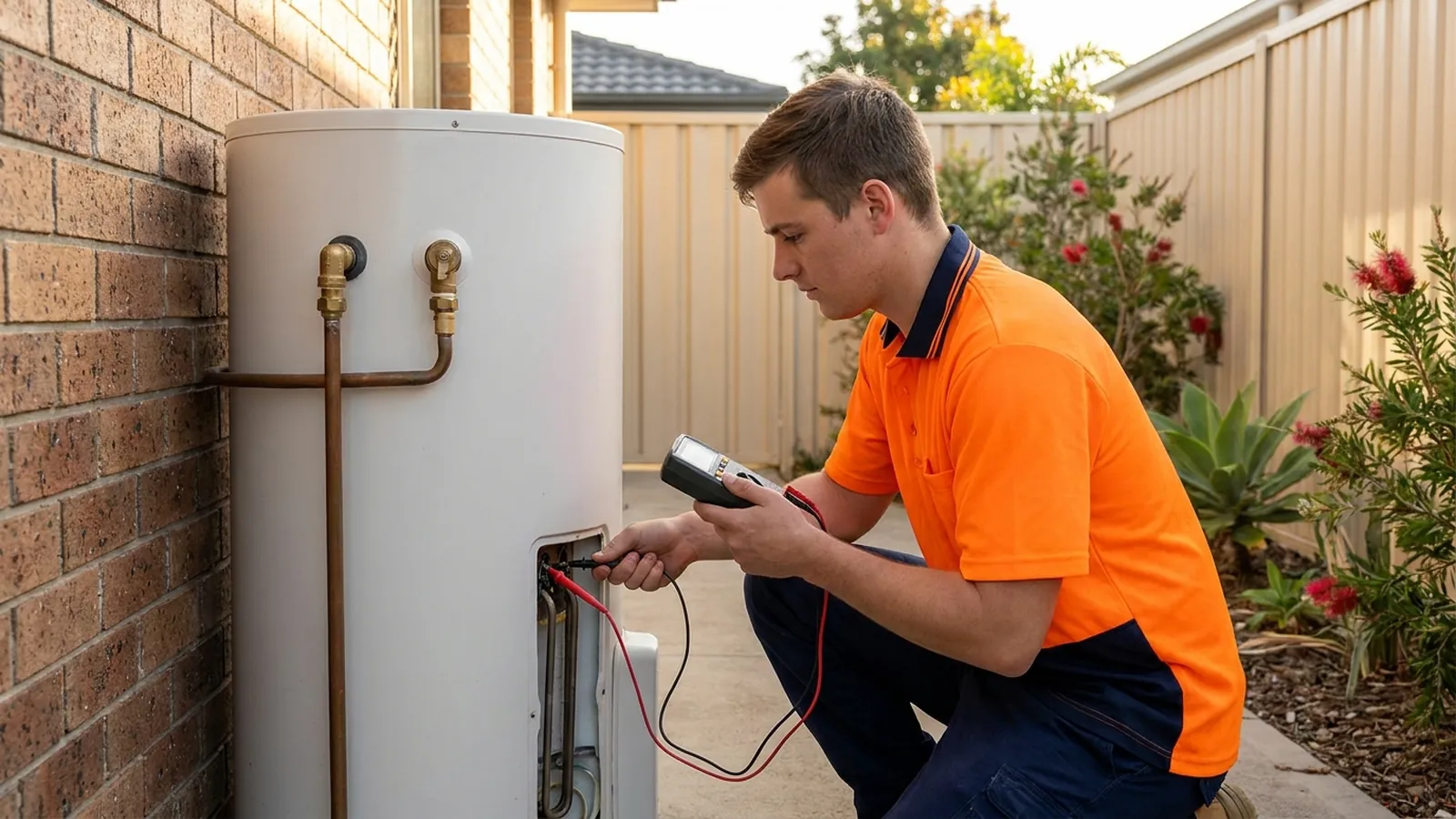
Hot water fault finding on the north side
Cold shower at 6am. That's usually how we hear about it.
Most people blame the tank. Plenty of the time the tank is fine and the fault sits on the electrical side: a burnt out element, a thermostat that's stopped switching, a breaker or safety switch that's let go at the board, or off-peak wiring that never turns the tank on overnight. That's our part of the job. We find what's actually wrong, explain it in plain English, then fix the electrical side properly.
Fault finding is diagnostic work before it's repair work. From the bathroom tap, an element that's failed to earth looks exactly the same as a thermostat with welded contacts. A dead controlled load relay looks the same as a breaker that's quietly tripped behind the switchboard door. Guess, and you pay for parts you never needed. We test first, every time.
We work on electric storage tanks, heat pump units, and the electric booster on solar hot water. Houses, townhouses, unit blocks and small commercial sites. Our patch runs from Albany Creek and Warner out through Strathpine and Petrie, north to Narangba and Burpengary, and east across to Redcliffe. We don't run up to Caboolture. If you're past our patch we'll say so on the phone instead of wasting your morning.
Who calls us for this? Homeowners with a houseful of people and no hot water. Landlords and property managers with a tenant ringing about a cold shower. Small business owners who need a staff kitchen or a hand basin back on before they open. Plenty of people ring after a plumber has already been out, checked the tank, found it sound and told them they need a sparky.
There's one line we hold to. Tanks, valves and plumbing connections belong to a plumber. If we turn up and find water pooling under the unit or dripping from the relief valve, we'll tell you straight away and point you at the right trade. We won't drag the job out to make it ours.
What you'll notice, and what usually causes it
Customers describe hot water faults in about six ways. Here's what each one normally means once we get the covers off.
No hot water at all. Dead tank. Most of the time that's the element, the thermostat, or supply not reaching the unit. An element sits in water for years and the sheath eventually gives way. Sediment builds up around the lower element in hard working tanks and cooks it. When an element fails it often fails to earth, which brings the safety switch down with it.
Lukewarm water, or hot water that runs out fast. Twin element tanks have an upper and a lower element. Lose the lower one and only the top third of the tank heats, so you get a short burst of warm water and then cold. A thermostat that's drifted out of calibration does something similar. A lot of the calls we take from North Lakes estate homes start with "it was fine last week, now it lasts four minutes".
The safety switch trips whenever the hot water is on. Take this one seriously. A repeat trip usually means current is leaking to earth, most often through a failed element or through water that's got into the isolator or the terminal cover. Flick it back once. If it goes again, leave it off and ring us.
Hot water only works if someone flicks a switch. Off-peak, or controlled load, is what Energex runs as tariff 31 and tariff 33. The tank is meant to switch itself on overnight when the cheaper rate is live. When the control relay or the wiring behind it gives up, nothing tells the tank to heat. We see this after meter changeovers, where the controlled load wiring hasn't gone back the way it came out.
Scalding water, or the relief valve letting go over and over. A thermostat stuck closed keeps feeding the element long past temperature. That one is a genuine safety risk. Switch it off at the isolator and call us.
A burning smell, scorch marks or a buzzing isolator. Stop there. Kill the circuit at the switchboard and phone us. Heat at a connection means a loose or corroded terminal, and loose terminals start fires.
Now the local part, because these faults cluster in certain streets for a reason. It comes down to the houses.
Older homes around Petrie, Strathpine and Kallangur often still run a board with ceramic fuses or early circuit breakers, and no safety switch on the hot water circuit at all. Wiring from the 60s and 70s goes brittle where it terminates. Rewires around here tend to happen in stages, so you'll find a modern kitchen circuit sitting alongside a hot water run nobody has touched since the house went up. When an element lets go in a house like that, the old wiring and the tired board are usually part of the story. We check both before we quote a repair.
Out at Redcliffe and along the bay, salt air does the damage. Outdoor tanks, isolators and weatherproof outlets corrode from the inside out. We pull covers down there and find green terminals and screws you can't get a bite on. Corrosion adds resistance, resistance makes heat, and heat finishes off the connection.
In the newer estates through Narangba, Mango Hill, North Lakes and Burpengary the tanks are younger, but they're usually outside on a slab in full western sun or squeezed into a tight side setback. Water finds its way into element covers. Ants and cockroaches get into isolators, which sounds like a joke until you see one shorted out and blackened.
Then there's the weather. Storm season across Moreton Bay drops power, spikes circuits and soaks gear that was never built to cop that much water. We take a run of hot water calls after every decent one.
How we run the job, start to finish
You ring us and tell us what it's doing. We'll ask a few things on the phone: the brand on the tank, roughly how old it is, whether it's electric storage, heat pump or solar boosted, and what's actually happening. Cold, lukewarm, tripping, or dead since the storm. That tells us what parts to load before we leave.
We confirm a time. Not "sometime Thursday". We book a window and we ring before we head over, so you're not sitting home guessing. If we're running behind on the job before yours, you'll hear from us.
We start at the switchboard, not the tank. It's the cheapest place to find the fault. We check the breaker or fuse, the safety switch, the controlled load side and whether supply is even getting out to the unit. A fair few jobs end right here, and that's a good outcome for you.
Then the isolator and the unit. We isolate, lock it off and prove it dead before anything comes apart. From there we test the element for resistance and for insulation to earth, check the thermostat is switching, measure the supply under load, and look hard at every termination for heat damage or corrosion.
We stop and explain it. Before any repair work starts you get told what we found, what caused it and what fixing it involves. Plain English, no trade talk you need to decode. Price gets agreed on the spot, before we pick a tool back up.
We do the repair. Elements and thermostats come in common sizes and we carry the usual ones, so most jobs get sorted on the same visit. Where the real problem is the circuit or the switchboard, we'll fix what's safe to fix and price the rest separately so you can decide.
We test it and prove it's working. The circuit gets reinstated and tested, we check the tank is drawing what it should, and we test the safety switch. If we've touched the wiring, you get a Certificate of Testing and Compliance for the work.
We clean up and tell you what to expect. Covers back on, screws back in, rubbish in our ute, floor swept. A full tank takes a few hours to come up to temperature, so we'll tell you when to expect hot water rather than leaving you to panic at 4pm.
Gear, parts and the standards we work to
Fault finding is only as good as the testing behind it. We carry a multimeter, a clamp meter and an insulation resistance tester, and we know what the numbers should read on a healthy element. An element that measures fine on resistance can still be leaking to earth, and you only catch that with the right test. That's the difference between a repair that holds and a callback in three weeks.
Parts get matched to the unit, not to whatever's rattling around in the van. Elements are chosen for the right rating, thread and length for that tank, and the circuit has to suit the rating. Thermostats need the correct stem length and a working safety cut out. Outdoor isolators go back as properly rated weatherproof units, because a cheap one on a Redcliffe wall is a repeat visit waiting to happen.
All work is done to AS/NZS 3000, the Wiring Rules, with testing and verification to AS/NZS 3017. In Queensland that sits under the Electrical Safety Act 2002 and the Electrical Safety Regulation 2013, which is why hot water wiring, switchboard work and hard wired connections are licensed electrician work only. Where we alter or extend a circuit, it gets brought into line with the current rules, and that means safety switch protection on that circuit.
Off-peak and tariff work has its own boundary. The wiring on your side of the meter is ours. Metering itself, and the controlled load setup behind it, sits with Energex and your retailer. If that's where your fault is, we'll tell you exactly who to ring and what to ask for, so you're not bounced around for a week.
Heat pumps have a boundary too. We handle the circuit, the isolator, the controls, the booster element and the wiring at the board. The sealed refrigeration side of a heat pump is manufacturer or service agent territory, and we'll say so rather than open something we shouldn't. Solar hot water works the same way: the electric booster and its circuit are ours, the collectors and the plumbing aren't.
No hot water today? Here's how we handle urgent calls
We're honest about hours. We're on the tools Monday to Friday, 7am to 5pm, and Saturday mornings from 7am to 11am. We're not open around the clock and we won't pretend to be. What we will do is answer the phone and give you a straight answer about when we can get there.
Being based in Warner keeps travel short across Strathpine, Petrie, Kallangur, Albany Creek and Eatons Hill. When you ring, we'll book a time we'll actually keep. Nobody likes being told "we'll try" and then hearing nothing.
While you're waiting, a few things keep it safe. If the safety switch has tripped on the hot water circuit, reset it once. If it trips again, leave it off. Repeated resetting doesn't fix a fault and it isn't safe. If you can smell burning, hear buzzing or see scorching around the isolator, switch that circuit off at the board and leave it off until we get there. If water is pooling under the tank, shut the water off to the unit and ring a plumber first, then us if the electrical side still needs looking at.
Two things worth knowing. A tank on off-peak that failed overnight often won't be back to full hot until the next heating cycle, even after a quick repair. And if you've got a second bathroom running off a separate instantaneous unit, that one may well be unaffected while the main tank is out.
Call us on 0491 105 475 and describe what it's doing. We'll tell you whether it's urgent, whether it's ours or a plumber's, and when we can be there.
Why north side homeowners call us
97 Electrical is Jake's business, run out of Warner. Three years on the tools under his own name, working a tight patch he knows well. When you call, you're talking to the bloke who'll be doing the work. No call centre. No subcontractor you've never met turning up in an unmarked van.
We're rated 5.0 on Google. What we aim for on every hot water call is simple: turn up when we say, explain what's going on, leave the place clean. Covers back on, floor swept, nothing left behind in your yard.
Jake's a licensed electrician, and everything we do gets tested and certified. That matters more than people realise on hot water work, because a failed element leaking current to earth is a real shock risk. It's also why we tell people to stop resetting the safety switch and call someone licensed instead.
We'll tell you when it isn't our job. Plumbers do tanks, valves and pipework. Manufacturers do sealed heat pump components. Energex does metering. Knowing where that line sits saves you a wasted call out, and we'd rather send you to the right trade than charge you to find out.
Local knowledge counts for something too. We know what's behind the walls in the older homes around Petrie and Strathpine, what salt air does to gear at Redcliffe, and how the estate builds through North Lakes, Mango Hill and Narangba are put together. Less time hunting, faster answer for you.
No hot water, lukewarm water, or a safety switch that keeps tripping on the hot water circuit? Ring 97 Electrical on 0491 105 475 with the brand and rough age of your system, or head to 97electrical.com.au. We'll confirm a time and come and find the fault.
Frequently asked questions
How do I know if it's an electrical fault or the tank itself?
Water cold or lukewarm with no leak showing? That usually points to the element, the thermostat or the circuit at the switchboard, which is our work. Water pooling under the tank or dripping from a valve is plumbing. Ring us on 0491 105 475, describe what you're seeing, and we'll tell you honestly who you need.
What does it cost to find and fix a hot water fault?
It depends on the fault and the unit, so we won't guess over text. Call 0491 105 475 with the brand, the rough age of the system and what it's doing, and we'll talk you through a price on the phone.
My hot water circuit keeps tripping the safety switch. Can I just reset it?
Flick it back once. If it trips again, leave it off and call a licensed electrician. A repeat trip means there's a real fault, often an element leaking current to earth. Resetting it over and over doesn't fix anything and it isn't safe.
When can you come out?
We're on the tools Mon to Fri 7am to 5pm and Sat 7am to 11am. Call 0491 105 475 and we'll confirm a time rather than leaving you guessing.
Do you work on heat pump and solar hot water systems?
We handle the electrical side of both: the circuit, the isolator, the boosters and the wiring at the board. Sealed refrigeration parts inside a heat pump usually need the manufacturer or their service agent. Not sure which system you've got? Send a photo of the unit's label to 0491 105 475.
My hot water stopped after a new meter went in. What's happened?
That's a common one. Off-peak, or controlled load, is meant to switch the tank on overnight by itself. After a meter changeover the controlled load wiring sometimes doesn't go back the way it came out. We'll test the circuit on your side of the meter, and if the fault sits with Energex or your retailer we'll tell you exactly who to ring.
How long until I have hot water again after the repair?
The repair itself is usually quick once we've found the fault. The tank then needs a few hours to heat a full load. If you're on off-peak it may not be back to full hot until the next heating cycle overnight, and we'll let you know before we leave.
Which suburbs do you cover for hot water fault finding?
We're based in Warner and cover Albany Creek, Eatons Hill, Cashmere, Strathpine, Petrie, Kallangur, North Lakes, Mango Hill, Narangba, Burpengary and Redcliffe. We don't go as far as Caboolture. Call 0491 105 475 and we'll tell you straight if you're outside the patch.