
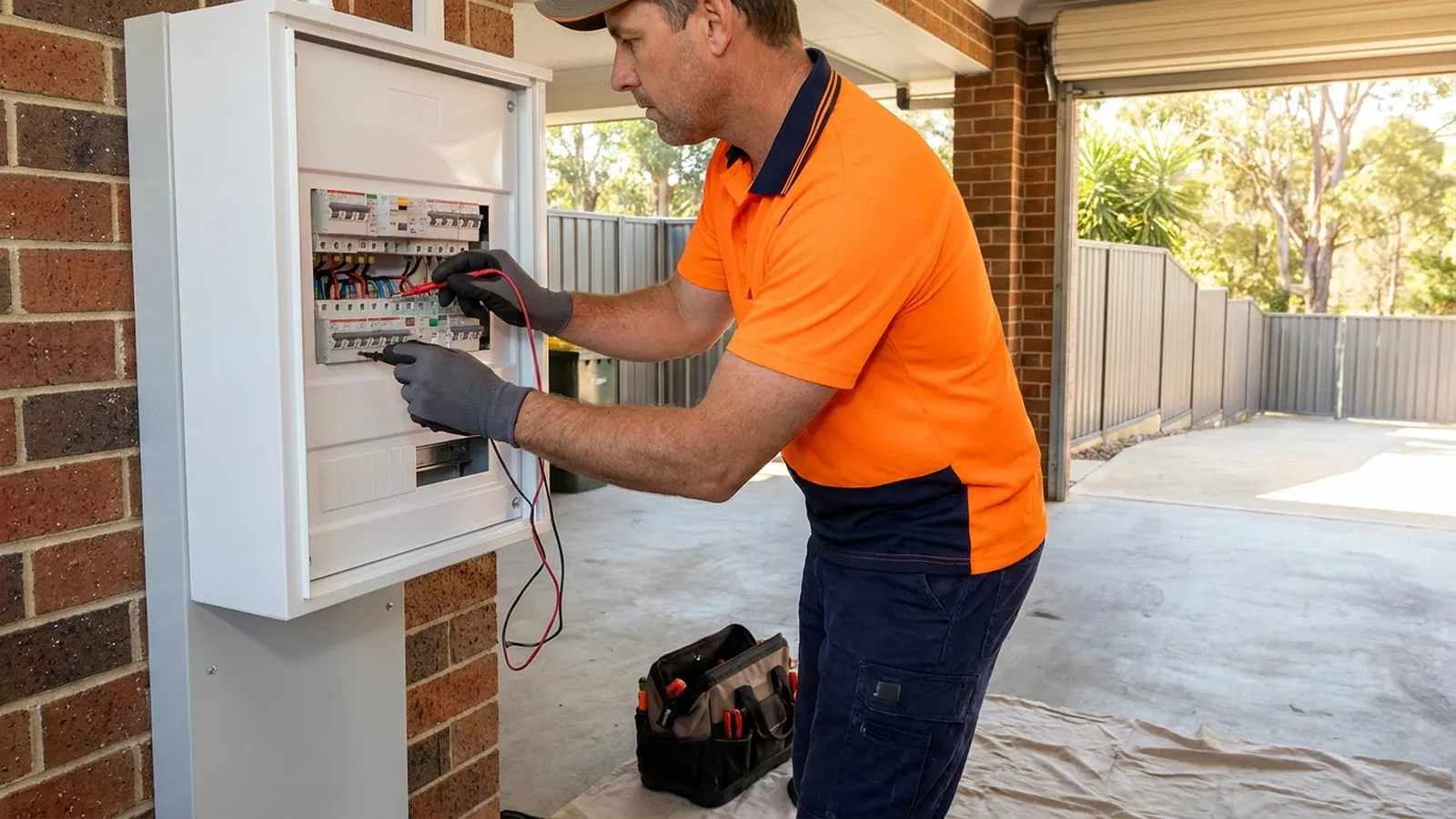
Fault finding, plain and simple
Something's stopped working and no one can tell you why. Half the house has no power. The safety switch won't stay up. A light flickers every time the aircon starts. Fault finding is the part of the job where we work out what's actually wrong, before anyone talks about a repair.
It's testing work. We isolate circuits at the switchboard one at a time and measure what each one is doing, then split the circuit down until the fault has nowhere left to hide. Insulation resistance, earth continuity, load current, safety switch trip times. Numbers, not guesses.
Most people ring us after they've had a crack at it themselves. Reset the board a few times. Unplug a few things. It behaves for a day, then it's back. That's normal and it doesn't mean you've done anything wrong. An electrical fault is a physical problem sitting in a cable, a fitting, an appliance or the board itself. It stays there until someone finds it.
We cover a tight patch on Brisbane's north side. We're based in Warner and work from Albany Creek out to Narangba and Burpengary, east to Redcliffe. That patch gives us just about every kind of house in one run. Estate homes in North Lakes and Mango Hill, fifteen or twenty years old, where faults usually come down to water or a failed appliance. Older places around Petrie and Strathpine running cable that went in decades ago. Bayside homes at Redcliffe where salt air eats outdoor fittings and meter boxes from the outside in.
The job is the same either way. Find it, prove it, explain it, fix it.
Who rings us for this? Homeowners with a board that trips every second night. Landlords and property managers fielding calls from tenants. Small businesses with a dead circuit in a shop, workshop or cafe. People who've just bought a place and inherited someone else's wiring. And plenty who've had one go at chasing it themselves and want it sorted properly this time.
What you notice, and what's actually causing it
The safety switch keeps tripping
A safety switch, or RCD, watches the power going out on a circuit and the power coming back. If some of it leaks away, usually to earth, the switch cuts the circuit in a fraction of a second. When it trips, it's doing its job.
The leak is nearly always one of four things. A faulty appliance, and kettles, toasters, old fridges, washing machines and pool pumps are the usual suspects. Moisture in an outdoor powerpoint or garden light, common after a summer storm. Damaged cable, often a nail or a screw driven through a wall during a reno. Or a light fitting that's cooked itself, which we see a lot with older downlights and cheap LED drivers.
Reset it once. If it goes again, leave it off and ring us. Resetting over and over on a live fault isn't safe.
A circuit breaker trips
Different problem. A breaker watches current, not leakage. It trips on overload or a short circuit. Overload means too much on the one circuit, and a kitchen running a kettle, toaster and microwave off the same run is the classic. A short circuit is a live and a neutral touching where they shouldn't, and that's a find-it-now job.
Power drops out when something turns on
The kettle goes on and the lights dip, or the circuit drops out altogether. Usually a loose connection, often a terminal at the board or inside a powerpoint that's worked its way loose over years of heating and cooling. Loose connections arc. Arcing makes heat. Heat starts fires. We treat this one seriously.
Flickering or dimming lights
Could be the fitting. Could be the driver. Could be a shared neutral that's come loose in a ceiling rose. It can also be a supply problem that belongs to Energex rather than your wiring. We test to find out which, because there's no sense swapping fittings if the trouble sits upstream of your board.
A warm powerpoint, a brown mark or a burning smell
Stop using it. Switch that circuit off at the board. This is the one we ask people never to sit on. Discolouration around a socket or a switch means heat, and heat in a fitting means a bad connection or a component on its way out.
Half the house is dead
Often a failed breaker, a blown fuse in an older ceramic board, or a lost neutral. Sometimes it's the main switch or the incoming supply. We check the board, then the supply, then the circuit.
Intermittent faults
The worst of them. Works all week, drops out on a Sunday night. Intermittent faults usually mean something is moving, heating or getting wet: a cable rubbing in the roof, a terminal expanding under load, water only finding its way in when the rain comes from the south east. These take longer, because we have to test under load and recreate the conditions.
Why north side homes throw these up
A few local reasons. Storm season pushes water into roof cavities, outdoor points and meter boxes. Salt air along the Redcliffe peninsula corrodes screws, terminals and outdoor enclosures faster than it does inland. Possums and rats chew cable insulation in roof spaces, and we find that in new estates as often as old homes. Renovations put nails and screws through cable behind plasterboard. And a fair few homes around Strathpine, Petrie and Kallangur still run original wiring, ceramic fuses or only partial safety switch protection, which makes a small fault harder to trace and more dangerous when it does show up.
How we do it, step by step
1. The phone call
Ring us on 0491 105 475 and tell us what's going on. Three things help most: what's not working, when it started, and what you were doing at the time. If you know which breaker or switch has tripped, say so. If you've already unplugged a few things and it made a difference, that's useful too. We'll ask a few questions and give you a straight answer on how soon we can get there.
2. A confirmed time, and we turn up
We lock in a time and we keep it. If the job before yours runs long, you get a call, not silence. That's the easiest promise to keep.
3. A look and a listen
First thing on site, we walk the problem with you. What's dead, what's tripping, what you've noticed and when. Then the switchboard cover comes off. A lot of the story is visible from there: heat marks, loose terminals, a board with no safety switches, old ceramic fuses, water staining, someone else's rushed patch job.
4. Safe isolation and testing at the board
We isolate the circuit and start measuring. Insulation resistance testing tells us whether the cable insulation has broken down. Earth continuity confirms the earth path is intact. RCD testing tells us whether the safety switch trips inside the times the standard allows. At this stage we're working out which circuit owns the fault, not yet where along it the fault sits.
5. Splitting the circuit down
Once we know the circuit, we divide it. Disconnect at a midpoint, test each half, keep halving until the fault is cornered in one section of cable or one fitting. If a run needs tracing through a wall or a ceiling, we use a cable locator rather than cutting holes to have a look around.
6. Testing under load
Intermittent faults won't show on a dead circuit. So we put load on it and watch what happens with a clamp meter, sometimes running the appliance that triggers it while we measure back at the board. This is the part that eats time, and we'll keep you posted as we go rather than vanishing into the roof for two hours.
7. We tell you what we found
Plain English, standing in front of the thing that's wrong wherever we can show you. What failed, why, what the repair involves and what happens if it's left. If there's more than one option, you get both, and the difference between them explained without the sales pitch.
8. Repair, or a quote
Most faults get fixed on the same visit. We carry common parts in the van: powerpoints, switches, breakers, safety switches, light fittings, connectors. A failed socket or a dodgy switch usually gets sorted then and there. Bigger work like a switchboard upgrade or a section of rewire gets priced first and booked in, so nothing lands on you as a surprise.
9. Retest, then tidy up
After any repair we test again to confirm the circuit is behaving: insulation, earthing, polarity and RCD operation. Where we've done installation work you get a Certificate of Testing and Compliance, which is the paperwork Queensland requires from a licensed electrician. Then we clean up. Drop sheets down, dust vacuumed, offcuts and packaging go with us.
Test gear and the rules we work to
Fault finding is only as good as the instruments and the method behind it. What gets used on a typical fault call:
- Multimeter, for voltage, resistance and continuity checks at the board and at individual fittings.
- Insulation resistance tester, which pushes a test voltage through the cable insulation to see whether it's broken down. This is what catches water in a circuit and perished old insulation.
- Clamp meter, for reading current under load without disconnecting anything. It's how we pick up overloads and unbalanced circuits.
- RCD tester, for measuring real safety switch trip times and trip currents against the limits in the standard. A 30mA safety switch has set times it must operate within, and plenty of old ones no longer make it.
- Earth loop impedance tester, to confirm the fault loop is low enough that the protection will actually operate when it needs to.
- Cable locator and tone tracer, for following a cable through a wall or ceiling instead of guessing where it runs.
The standards behind the work:
- AS/NZS 3000, the Wiring Rules. The main standard for electrical installations in Australia. It sets how circuits are installed, protected and tested.
- AS/NZS 3017, the testing guidelines. Procedures and acceptable results for insulation resistance, earth continuity, polarity and RCD operation.
- AS/NZS 3019, periodic verification of existing installations. The framework for checking wiring already in service rather than brand new work.
- Queensland's electrical safety laws. Installation work in this state is licensed work. Testing, repairs and anything inside the switchboard are not DIY jobs, and the fines are the least of the reasons why.
When it can't wait
Some faults can't wait. Here's how we handle the urgent end, and where we honestly sit on hours.
We're on the tools Monday to Friday, 7am to 5pm, and Saturday mornings 7am to 11am. We're not a 24 hour call-out outfit. What we will do is take the call, tell you straight when we can get there, and tell you what to do in the meantime. If someone else can get to you faster, we'll say so rather than leave you hanging.
Treat these as urgent:
- Burning smell, smoke or a scorch mark around a powerpoint, a switch or the switchboard. Switch that circuit off at the board and stop using it. If there's smoke or flame, ring 000 first.
- A powerpoint or switch that's hot to touch.
- A safety switch that trips the instant you reset it, every time. Leave it off.
- Water through the roof or into the switchboard after a storm. Don't touch the board with wet hands or while you're standing in water.
- A shock or a tingle off a tap, an appliance or a fitting. Turn the main switch off and ring us straight away. Don't wait on that one.
If the whole street is out, it's a network problem, not your wiring. Call Energex on the faults and emergencies number printed on your power bill. If it's only your place and the neighbours have power, it's on your side of the meter and that's our end.
Storm season gets busy. After a decent cell comes through Albany Creek, Warner and Eatons Hill we usually cop a run of calls about tripped boards and dead circuits from water. Ring early in the day if you can. It gives us a better shot at fitting you in.
Why people ring 97 Electrical
97 Electrical is Jake's business, run out of Warner and going on three years now. Jake's a licensed electrician and still on the tools every day, so the bloke you speak to on the phone is generally the bloke who turns up.
What you get from us:
- We turn up when we say we will. We return calls and keep the time we booked, and we're rated 5.0 on Google.
- We leave it tidy. Drop sheets, vacuum, rubbish taken away.
- We explain the job. Trade terms get translated as we go, so you know what an RCD is, what it's telling you and what your options are before any money gets spent.
- We work a tight patch: Albany Creek, Warner, Eatons Hill, Cashmere, Strathpine, Petrie, Kallangur, North Lakes, Mango Hill, Narangba, Burpengary and Redcliffe. We don't go up to Caboolture. Staying close means we know the housing, and it means shorter trips when something's urgent.
- We carry parts. Common fittings, breakers and safety switches ride in the van, so a straightforward fault usually gets repaired on the first visit.
- Fault finding often leads into other work: switchboard upgrades, safety switch installs and interconnected smoke alarms. If your fault is a symptom of a board that's past its day, we'll tell you what a proper fix looks like and quote it before you commit to anything.
Got a circuit that keeps tripping, a dead run of powerpoints or a light that flickers every time the aircon kicks in? Don't sit on it. Ring 97 Electrical on 0491 105 475 or head to 97electrical.com.au and we'll book you a time.
Frequently asked questions
My safety switch keeps tripping. What's causing it?
A safety switch (RCD) cuts the power fast when it picks up a fault, so a trip means it's working. Nine times out of ten it's a faulty appliance, moisture in an outdoor point or damaged wiring. Unplug everything on that circuit and reset it once. If it trips again, leave it off and ring us on 0491 105 475. Don't keep resetting it.
How long does fault finding take?
Depends on the fault. A single dead circuit or a dodgy appliance can be found in under an hour. Intermittent faults, the ones that only show up sometimes, take longer because we have to test under load and recreate the conditions. We'll tell you where we're at as we go rather than leaving you wondering.
What does fault finding cost?
We can't quote it properly without knowing what we're chasing. Give us a ring on 0491 105 475, tell us what's happening and when it started, and we'll talk you through how we charge for it before we come out.
Can I look for the fault myself first?
You can switch circuits off at the board and unplug appliances one at a time to see what changes. That genuinely helps us. But don't open the switchboard, pull a powerpoint off the wall or touch any wiring. That's licensed electrician work and live circuits can kill.
Do you fix the fault on the same visit?
Most of the time, yes. We carry common parts in the van, so a failed powerpoint, switch, breaker or light fitting usually gets sorted then and there. Bigger jobs like a switchboard upgrade or a section of rewire get quoted first, then booked in.
Half my house has no power but the neighbours are fine. What's the go?
If your neighbours have power, the problem sits on your side of the meter and that's our job. It's often a failed breaker, a blown fuse in an older ceramic board or a lost neutral. If the whole street is dark, it's a network issue and you want Energex on the faults number printed on your power bill.
There's a brown mark around a powerpoint and it feels warm. Is that urgent?
Yes. Stop using that outlet, switch the circuit off at the board and ring us. Heat around a socket means a bad connection or a component that's failing, and bad connections arc. If you can see smoke or smell burning, call 000 first, then call us.
What suburbs do you cover?
Albany Creek, Warner, Eatons Hill, Cashmere, Strathpine, Petrie, Kallangur, North Lakes, Mango Hill, Narangba, Burpengary and Redcliffe. We don't go as far north as Caboolture. Our hours are Monday to Friday 7am to 5pm and Saturday 7am to 11am, and you can reach us on 0491 105 475 or at 97electrical.com.au.