
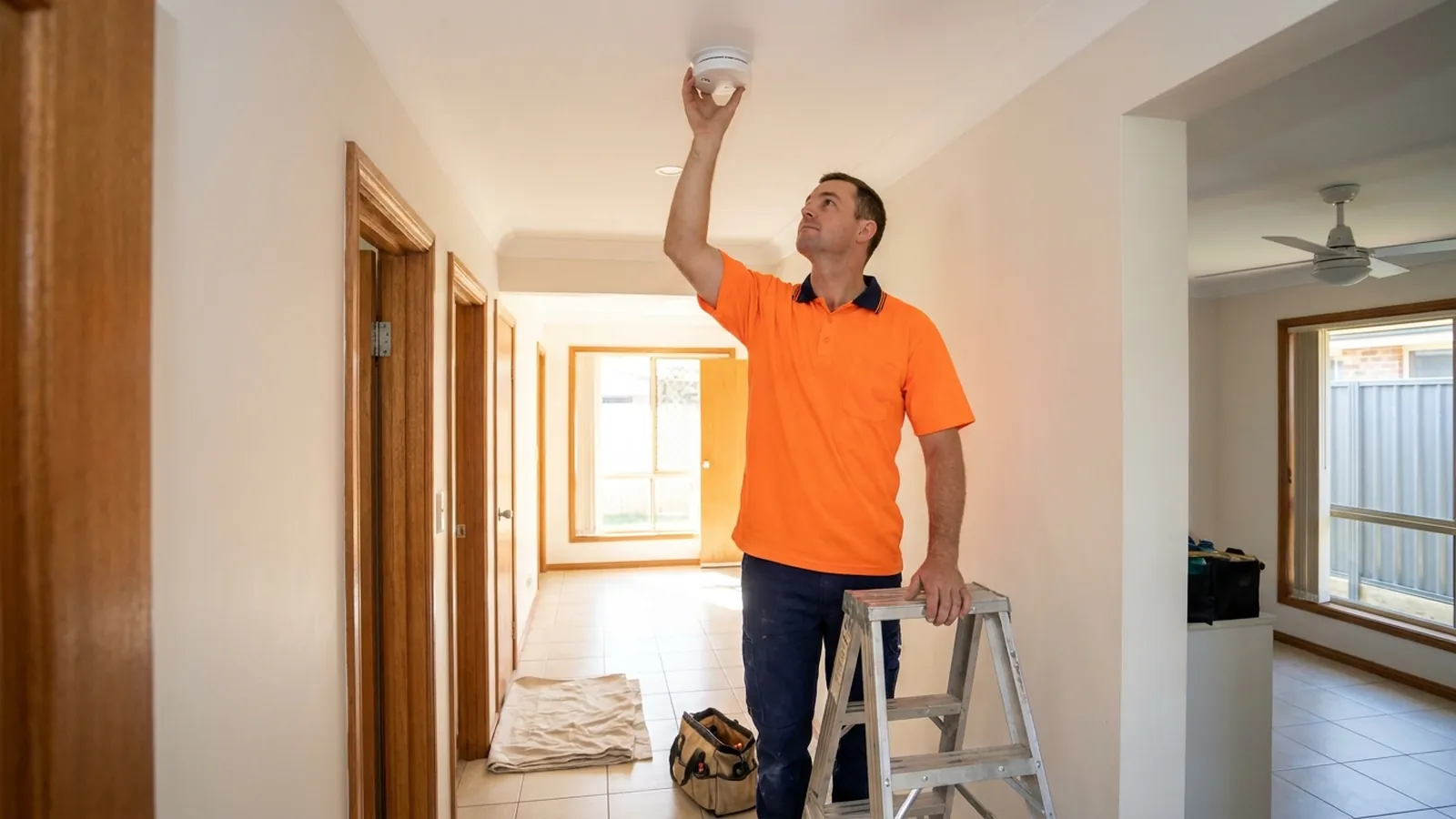
Smoke alarm installs across Brisbane's north side
Queensland's smoke alarm rules came in over a few stages, and the last one lands on 1 January 2027. From that date, every home in the state, including owner occupied homes, needs interconnected photoelectric smoke alarms. If you're selling or leasing a place, you've needed them since 1 January 2022. That 2027 date is close now.
Here's what those two words mean in plain English. Interconnected means the alarms talk to each other. One picks up smoke and every alarm in the house sounds at once, so a fire in the lounge at 2am wakes the kids at the far end of the house. Photoelectric means the sensor uses a light beam to spot smoke particles, instead of the old ionisation sensor most homes were built with. Photoelectric alarms pick up smouldering fires earlier. Smouldering is how most house fires start: a power point, a lamp against a curtain, a charger left on the lounge.
We install and replace alarms in houses, townhouses, duplexes and units right across the north side. Albany Creek and Warner, through Strathpine, Petrie and Kallangur, out to Narangba and Burpengary, and east to Redcliffe. Owner occupied, investment property, or about to hit the market. The standard is the same and so is the work.
Most north side homes need three to eight alarms once you count it out. One in every bedroom. One in every hallway that connects bedrooms to the rest of the house. At least one on every storey, including a storey with no bedrooms on it. A four bedroom lowset in Narangba usually lands on five or six. A double storey in Eatons Hill with a rumpus downstairs can be seven or eight.
The people who ring us about this are usually one of four. Homeowners who've read about the 2027 date and want it off the list. Landlords and property managers getting a place ready for a new lease. Sellers whose conveyancer has asked about the smoke alarm section on the contract. And people whose alarm has been chirping at 3am for a week straight.
You'll get a price over the phone. Tell us bedrooms, hallways and levels and we can work it out without coming to look first. Most jobs are a few hours, start to finish, and the old alarms leave in our ute.
What people notice before they call
The 3am chirp. One short beep every 30 to 60 seconds, always at night. That's the low battery warning, and it gets worse in the cold because battery voltage drops with temperature. Half the time the battery isn't the real problem. The alarm is past its ten year life and the sensor is on the way out.
It goes off every time someone makes toast. Ionisation alarms are famous for this. They react to the fine particles in cooking fumes and steam, and in the open plan estate homes around North Lakes and Mango Hill the kitchen sits a few metres from the hallway alarm. People pull the battery out to stop the noise. Then the house has no working alarm at all. We see it constantly.
Only one alarm sounds. Plenty of homes built between about 1997 and 2016 have 240V hard-wired alarms, which feels compliant enough. They're usually ionisation and usually not interconnected. One alarm in the hallway does nothing for someone asleep at the other end of a long lowset.
The alarm has gone yellow. Plastic yellows with UV and age. Twist it off the base and look at the back. There's a manufacture date or an expiry date printed on it. Ten years from manufacture and it's finished, whether it still beeps or not.
A letter from the property manager. Rentals have had to be compliant since 1 January 2022. Managers around Strathpine, Petrie and Kallangur send these out in batches, and owners often get about a fortnight's notice.
What's actually causing it
The sensor is the part that ages. Alarms are rated for roughly ten years because the chamber slowly fills with dust, insects and cooking residue, and the sensitivity drifts off. Nothing visible happens. It just gets less reliable.
Ceilings work hard up here. Roof spaces on the north side sit hot for months, and summer humidity pushes moisture into everything under the tiles. Older lowset brick and tile homes around Petrie, Strathpine and Kallangur have dusty ceiling cavities and thirty year old wiring, and the alarm chamber picks up the lot. Out at Redcliffe there's salt in the air as well, and it gets into the terminals and base contacts even a few streets back from the water.
Insects are the other one. Midges and tiny ants get into the chamber and set the thing off with no smoke anywhere in the house. There's not much you can do beyond keeping the alarm clean and replacing it on schedule.
Then there's where they were mounted. A lot of older alarms went up wherever the ceiling batten happened to be. Too close to a corner, right beside a downlight, or straight under the air con vent. Corners hold dead air, so smoke takes longer to reach the sensor. Vents and ceiling fans push smoke away from it. Both leave you with an alarm that looks fine and responds slower than it should.
One more we get called out for: a renovation. Knock a wall out, add a bedroom, close in the garage, and the alarm layout that was right before isn't right any more. Same goes for a new ceiling fan installed a foot from an existing alarm.
How the job runs, first call to done
The phone call. Ring 0491 105 475 and you'll usually get Jake. We ask four things: how many bedrooms, how many hallways connect those bedrooms to the rest of the house, how many storeys, and whether your current alarms are hard-wired or battery. If you can twist one off its base and read the date on the back, even better. That's enough for a price over the phone. No site visit, no waiting three days for a quote to land in your inbox.
Booking a time. We're on the tools Monday to Friday, 7am to 5pm, and Saturday mornings 7am to 11am. We'll confirm a window and let you know if we're running early or late. Got a settlement date or a tenancy starting? Tell us on the phone and we'll work to it.
Walking the house. First thing on site, we walk through and mark the positions with you. Every bedroom, the hallways, each storey. We check clearances at the same time: at least 300mm off any wall or corner, 300mm clear of a light fitting, and 400mm from an air con vent or the tip of a ceiling fan blade. Raked ceiling in the main bedroom? The alarm goes on the slope, between 500mm and 1.5 metres down from the apex.
Power off. For hard-wired work we isolate the circuit at the switchboard and test it dead before anything comes off the ceiling. With the board open we'll have a quick look at it. If there's a ceramic fuse board or no safety switches on the circuits, we'll tell you what we're seeing and whether it can wait. No pressure either way.
Old ones down, new ones up. The old alarms go in our bin, not yours. Bases get screwed to a solid fixing in the ceiling. A hard-wired install connects to the lighting circuit with the backup battery in place. On most retrofits we use wireless interconnection, so the alarms pair over radio and we're not running cable through finished ceilings. That saves cutting and patching your plasterboard, and it's why a whole house is usually a morning's work instead of two days.
Pairing and testing. Once they're all mounted we pair them and test the lot. We hold one alarm down and stand in the furthest bedroom to hear it, then do the same from the other end of the house. Every alarm gets tested on its own and as part of the group. We'll show you the hush button too, because you'll want it the first time someone burns the toast.
Cleaning up. Ceiling dust gets vacuumed, drop sheets come up, floors get a sweep. Tidy work is the part we take seriously. You shouldn't be able to tell we were there, apart from the new alarms.
Paperwork and payment. Invoice comes through by email. Landlords and property managers get the install details for their records, including where each alarm sits and what type went in, so it's on file for the next lease. Ask and we'll send photos with it.
Gear and standards we work to
We only fit alarms that meet AS 3786-2014, the Australian standard for smoke alarms. Queensland law wants that standard, photoelectric sensing, an alarm less than ten years old that sounds when you test it, and interconnection with every other alarm in the home.
There are two ways to power them.
240V hard-wired with a backup battery. Fed from the lighting circuit at the switchboard and wired to AS/NZS 3000, the wiring rules. This is what goes into new builds, renovations where the ceiling is already open, and homes that already have hard-wired alarms sitting there. Mains powered, with a battery that carries it through a blackout.
Ten year sealed lithium battery. The battery is built in and can't be taken out, so nobody can pull it to stop a chirp. Under Queensland law, when you replace an existing battery powered alarm it has to be photoelectric with a non removable ten year battery. These are what we use on most retrofits in older homes with no hard-wired alarms already in place.
Both types interconnect. On retrofits we almost always go wireless, using radio frequency interconnection between the alarms. Worth knowing: alarms only pair with others from the same family, so we don't mix brands through a house. If you've already got a couple of compliant alarms from one range, read us the model over the phone and we'll match them rather than replacing everything.
Where they go is written into the legislation too, and it's stricter than most people expect:
- Every bedroom, on the ceiling
- Every hallway that connects bedrooms to the rest of the home
- Where there's no hallway, between the bedrooms and the rest of that storey
- Every storey with no bedroom on it, in the likely path out of the house
- Not within 300mm of a corner or a light fitting
- Not within 400mm of an air con vent or the blade tip of a ceiling fan
- Not in bathrooms, laundries or garages, and not right outside a bathroom door where steam will set it off
The rules sit in the Fire Services Act 1990 and the Building Fire Safety Regulation 2008, with the building side covered by the Queensland Development Code. You don't need to read any of it. We do, and we'll tell you what your place needs in a two minute phone call.
Hard-wired work has to be done by a licensed electrician. That's the law, and 240V in a hot ceiling cavity is not a Sunday project. Battery alarms you can legally fit yourself. Plenty of people still get us to do it, because the positions and clearances are the part that decides whether the house is compliant, and that's easy to get wrong.
When it's urgent
We'll be straight with you: We're on the tools Monday to Friday 7am to 5pm and Saturday 7am to 11am, and Jake answers the phone himself most of the time.
Here's how the urgent ones get handled.
A chirping alarm keeping you awake. Annoying, not dangerous. Ring us during business hours and we'll book you in. If it's a battery alarm you can safely reach, take it down and leave it outside the bedrooms overnight, somewhere you'll see it in the morning so it actually gets replaced. Don't leave the rest of the house relying on an alarm that's already told you it's done.
An alarm sounding with no fire. Get everyone out and check the house before you decide it's a false alarm. If it's genuinely nothing, press the hush button. Never pull the battery and walk away from it. A house full of dead alarms is exactly what these rules exist to stop.
A burning smell, a hot power point, or smoke coming from the ceiling. Don't ring us first. Get everyone out and call 000. Once the place is safe, give us a call and we'll find the fault.
Storm season. Power comes and goes across Moreton Bay through summer, and hard-wired alarms often start chirping after an outage because the backup battery has been flogged. If yours are chattering the morning after a storm, that's usually the battery or the age of the unit. Worth a call.
Settlement or a lease starting. These have hard dates on them and we treat them that way. Tell us the date when you ring and we'll work to it. A full house of wireless interconnected alarms is a morning's work, so there's usually room to move.
Why people book us for it
97 Electrical is Jake Malcolm's business, run out of Warner and working a tight patch of the north side. Jake's a licensed electrician, he's been running the business about three years, and he's still on the tools every day. When you ring, you're talking to the bloke who'll be up in your ceiling.
We're rated 5.0 on Google. We confirm a time and turn up in it, we return calls, and we leave the house the way we found it with the dust vacuumed and the old gear in the ute.
A few other things worth knowing:
- We're local. Warner based, so nobody's driving up from the south side. Albany Creek, Warner, Cashmere, Eatons Hill, Strathpine, Petrie, Kallangur, Narangba, Burpengary, North Lakes, Mango Hill and Redcliffe is the patch. We don't head up to Caboolture.
- Priced on the phone. No waiting on a quote to come through days later.
- We explain it. You'll know what's going in, where, and why, before we start. If something isn't needed, we'll say so.
- Landlord paperwork sorted. Install details for your records, ready to hand to the agent.
Count your bedrooms, your hallways and your levels, then ring Jake on 0491 105 475 or head to 97electrical.com.au. Two minutes on the phone and you'll know what your place needs.
Frequently asked questions
Where should a smoke alarm go in a bedroom?
On the ceiling, as close to the middle of the room as you can get, at least 300mm off any wall or corner and 300mm clear of a light fitting. Keep it 400mm away from an air con vent or the blade tip of a ceiling fan, because the airflow pushes smoke straight past the sensor. In Queensland every bedroom needs its own photoelectric alarm, interconnected with the rest of the house. Raked ceiling? Mount it on the slope, between 500mm and 1.5 metres down from the apex. Not sure where yours should sit, ring 0491 105 475.
How much does it cost to install a smoke alarm?
It depends on how many alarms your home needs and whether it's hardwired. Call or send the form and we'll talk you through it.
Can I install a wired smoke alarm myself?
Hardwired smoke alarms are electrical work, so they must be installed by a licensed electrician. Call us and we'll sort it.
How do I change the 9 volt battery in a smoke alarm?
Twist the alarm off its base or slide the battery drawer open, unclip the old 9 volt, then press the new one onto the terminals until it clicks (it only goes on one way). Close it up, refit the alarm to the base, and hold the test button until it sounds. Two minutes, tops. If it keeps chirping on a fresh battery, the alarm is usually past its ten year life. Worth knowing: in Queensland a replacement battery alarm now has to be photoelectric with a sealed ten year battery, so the 9 volt ones are on the way out. Questions, ring 0491 105 475.
How many smoke alarms does my house need?
One in every bedroom, one in every hallway that connects bedrooms to the rest of the house, and at least one on every storey, including a storey with no bedrooms on it. They all have to be photoelectric and interconnected. Most north side homes land between three and eight. Tell us your bedroom count, hallways and levels on the phone and we'll work it out with you on 0491 105 475.
Do you have to run cables through my ceiling to interconnect the alarms?
No, not on most retrofits. We use wireless interconnection, where the alarms pair over radio, so there's no cable pulled through finished plasterboard and no patching afterwards. Hard-wired interconnection is for new builds, renovations with the ceiling already open, or homes that have hard-wired alarms on the circuit already. It's why a whole house is usually a morning's work.
I'm renting my place out. What do I need?
Rentals have had to comply since 1 January 2022. That means interconnected photoelectric alarms in every bedroom, in every hallway connecting bedrooms, and on every storey, with no alarm older than ten years. We do these for landlords and property managers around Strathpine, Petrie, Kallangur and Narangba, and we send through the install details for your records. Call 0491 105 475.
Do you install smoke alarms in my suburb?
If you're between Albany Creek and Narangba or Burpengary, or east towards Redcliffe, yes. That takes in Warner, Cashmere, Eatons Hill, Strathpine, Petrie, Kallangur, North Lakes and Mango Hill as well. We don't head up as far as Caboolture. Ring 0491 105 475 and we'll tell you straight away, or have a look at 97electrical.com.au.