
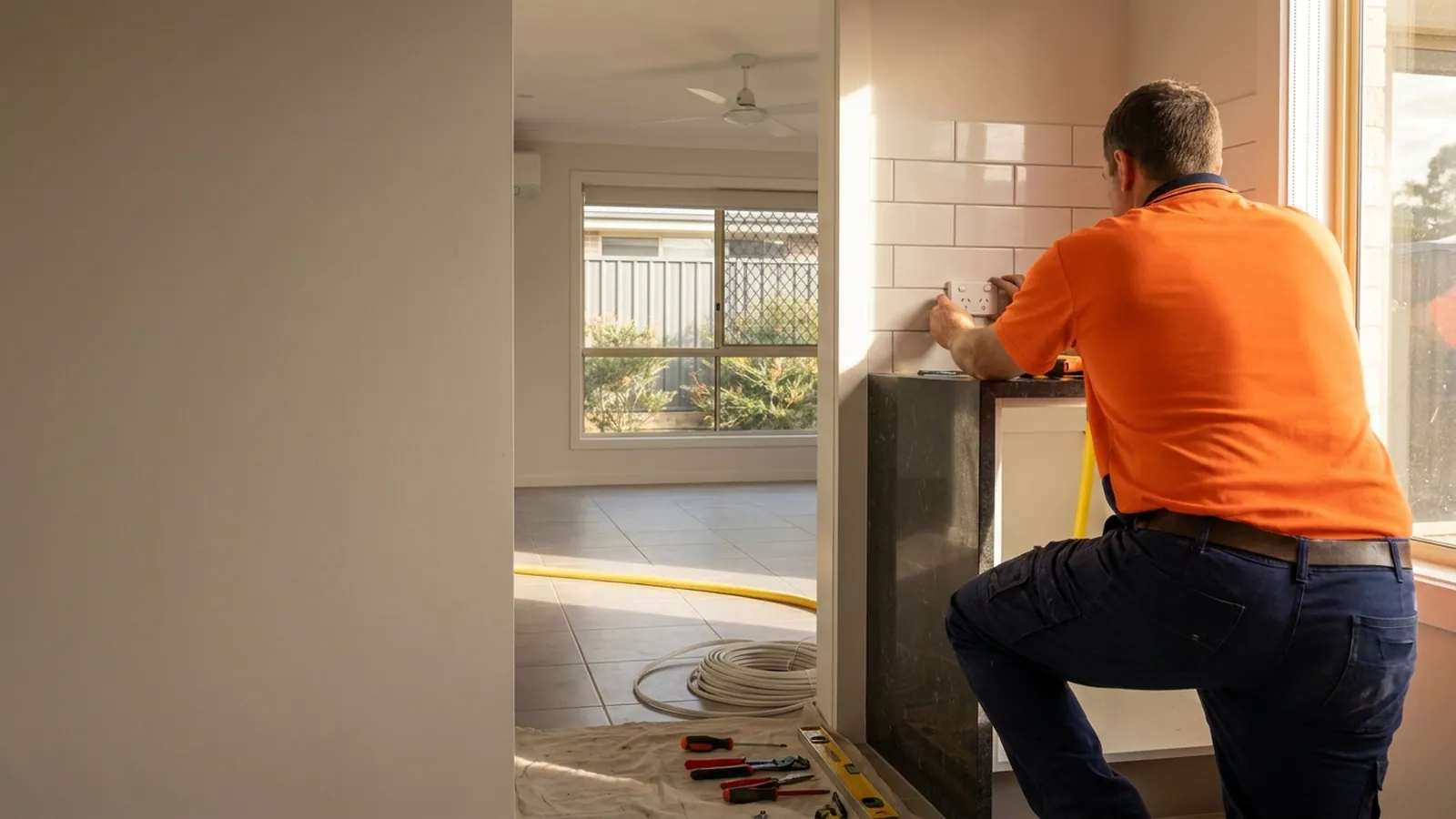
New power points across Brisbane's north side
Most of these jobs start with an extension lead. It runs under a rug, along a skirting board, or out a window to the barbecue. Someone finally gets sick of looking at it and rings us. Fair enough.
Adding a power point sounds like a ten minute job, and sometimes it is. The part that decides how long it takes is the bit you can't see. What's sitting in the wall cavity. How old the wiring is. Whether that circuit already has a safety switch on it. How far the cable has to travel from the switchboard, and what it has to get past on the way. We work all of that out before anything comes off the wall, then tell you what we found in plain English.
We install new points in houses, units, granny flats, sheds, shops and offices from Albany Creek and Warner across to Redcliffe. That covers single outlets and doubles, quad banks behind a desk or a TV unit, outdoor weatherproof points for the patio or the pool pump, USB points beside the bed so the phone charger stops taking up the only socket in the room, and dedicated circuits for an air conditioner, an oven, a cooktop, a pool pump or gear out in the shed. It also covers swapping out old sockets that have gone brown, loose or scorched. That's a smaller job than people expect, and a lot safer than leaving it.
Who calls us for this? Homeowners part way through a reno. People who just moved in and found one point in the whole lounge room. Landlords and property managers getting a place ready for tenants. Cafes and small shops adding a fridge, a display cabinet or a second coffee machine. Blokes lining a shed out the back who want a bench they can actually use. Home office setups where the desk ended up on the one wall with no power near it.
Worth saying up front. Adding a power point is licensed electrical work in Queensland. It isn't a weekend project and it isn't legal to do yourself, whatever the video shows. New cable has to be run, supported, terminated and tested properly, because a loose connection behind a wall plate gets hot, and hot is how house fires start.
What you notice, and what's really going on
There aren't enough points
Homes built through the sixties, seventies and eighties were wired for a different life. One point in a bedroom. Two in the lounge, if you were lucky. Nobody planned for a TV, a soundbar, a console, a modem, two chargers and a fan heater all wanting the same wall. The older streets around Strathpine and Petrie are full of these places. The fix is extra points where you actually use them, not another double adaptor stacked on the last one.
Newer estate homes in North Lakes, Mango Hill and Narangba have a different problem. There's usually plenty of power, just not where the furniture went. The builder put points where the plan said and the couch ended up somewhere else. Those runs are generally quick: gyprock walls, a roof space you can move around in, and a modern board with a spare way or two.
A socket has gone brown or smells hot
Discolouration around the pins means that connection has been arcing. Either a terminal screw has worked loose or the socket is worn and heating up every time the kettle goes on. Turn that circuit off at the board and stop using the point. Painting over the mark or swapping the cover plate hides the stain and leaves the heat exactly where it was.
The plug falls out
Old sockets lose their grip as the internal contacts weaken. The plug sits half in, the contact area shrinks and it starts arcing. Small job, cheap part, well worth doing before it scorches.
The safety switch trips when something gets plugged in
Sometimes it's the appliance. Sometimes it's moisture that's crept into an outdoor point, or a cable in the roof that a rodent has had a go at. Sometimes it's a genuine fault in the circuit. We test rather than guess, because replacing the socket when the trouble is eight metres of damaged cable gets you nowhere.
There's no point outside
A lead running out through a window or a sliding door is the standard workaround, and in wet weather it's a shock risk. Outdoor points need a sealed enclosure rated for where they sit, not an indoor socket with a plastic flap over it. Around Redcliffe the salt air chews through cheap fittings in a couple of summers. Summer storms push water sideways into anything that isn't gasketed and mounted to drain. We pick gear that suits the spot, and we mount it where the rain can't sit in it.
The switchboard is the real story
Plenty of older boards on the north side still run ceramic fuses, or old circuit breakers with no safety switch anywhere on the board. Adding a new point to a circuit like that isn't something we'll quietly do, because a safety switch is the thing standing between a fault and the person holding the plug. Homes around Kallangur, Petrie, Cashmere and the older parts of Eatons Hill often need the board sorted first. If that's your place, you'll hear it on the first visit with a plain explanation of what's needed and why, before you've spent anything.
Something big got added without checking the load
Air conditioners, ovens, cooktops, pool pumps, EV chargers and workshop gear all pull hard. Run one off a general power circuit that's already feeding half the house and you get nuisance tripping, warm cabling and an appliance that never quite performs. That work wants a dedicated circuit and a board with room for it. We check the board can carry it before we quote, not after the aircon is on the wall.
Rentals and shops
Landlords and property managers ring us when a tenant reports a loose or scorched socket, or when a place needs more points to be usable. Businesses ring us when the fitout moved and the power didn't. Either way we'll book a time that suits, and we'll put the report in writing so there's a record of what was done.
How the job runs, from first call to done
The phone call
Ring 0491 105 475 and we'll ask a handful of questions. What room, which wall, what's it for. Single storey or double. Brick veneer, weatherboard, hardiplank or block. Roughly how old the house is. Whether your switchboard has safety switches, and if you're not sure, whether you can send us a photo of the board. That's usually enough for us to know what we're walking into and to talk price properly, with the variables named rather than buried.
Confirming a time
We book a window and we confirm it. If a job earlier in the day blows out, you get a phone call, not silence. It isn't complicated. Turn up when you said you would.
The look before the work
The switchboard gets checked first: what protection is on which circuit, how loaded it is, whether there's a spare way. Then the route. Roof space or under the floor, timber or steel frame, noggings, insulation, plumbing or old wiring in the way, and where the cable can drop cleanly into the cavity. Double storey jobs and solid brick walls take more thought and sometimes a different path altogether. If the plan changes from what we talked about on the phone, you hear it before we start, not after.
Power off, cable in
The circuit gets isolated and proven dead. Then the cable goes in, clipped and supported, kept clear of sharp edges and away from hot spots like flues and downlight housings. In a north side roof space in February it's ordinary work done in serious heat, which is one reason we like to get these underway early.
Cutting in and terminating
The hole gets cut to the plate, not near enough to it. Mounting block or clips as the wall needs, cable dressed in neatly, terminations pulled up tight, nothing pinched behind the plate. The plate sits flush and level. That's the bit you'll be looking at in a year, so it's worth the extra minute.
Testing
Every job is tested before we call it done: earth continuity, polarity, insulation resistance and an RCD trip test on that circuit. Those readings either pass or they don't. If something upstream isn't right the test finds it, and that's a much better time to learn about it than the night it trips with the fridge on.
Cleaning up
Drop sheets go down before we start. We vacuum after ourselves, and the offcuts, packaging and old fittings leave with us. Insulation goes back where we moved it.
Walk through and paperwork
We switch it on, show you it working, and run through which circuit it's on and what that circuit will comfortably carry. Then the paperwork, including the certificate of testing and compliance where the work calls for one. If we spotted something else worth knowing about, the board or an old run of cable, it comes to you in writing with no pressure attached.
Shops, offices and tenanted places
For a business we'll book a time with you. We're on the tools Mon to Fri 7am to 5pm and Sat 7am to 11am. For tenanted homes, we deal with the tenant directly on access if the agent prefers, confirm the appointment with both, and send the invoice and paperwork where it needs to go.
Gear, fittings and the standards behind the work
Our work is done to AS/NZS 3000, the Australian and New Zealand Wiring Rules, and electrical work in Queensland has to be carried out by a licensed electrician under the Electrical Safety Act 2002. Those two things shape every call we make on a power point job. The parts that matter most to you:
Safety switches. The Wiring Rules require RCD protection on socket outlet circuits in homes. An RCD is a safety switch that compares the current going out with the current coming back, and cuts the power in a fraction of a second if any of it leaks somewhere it shouldn't, like through a person or a wet wall. 30mA is the rating used on socket circuits. If we're adding a point to a circuit with no RCD on it, the RCD is part of the job. The rules call for it.
Cable size and heat. A cable's current rating drops when it runs through a hot roof space buried in insulation, and Queensland roof spaces get savage in summer. We size cable for the real conditions, the real load and the length of the run, so there's no voltage drop at the far end and nothing working harder than it should.
Outdoor and coastal fittings. Weatherproof points need an IP rated enclosure, a lid that still shuts over a plugged in lead, a gasket that actually seals and mounting that lets water run off instead of pooling. Near the bay we choose fittings and fixings that cope with salt air. Stainless and UV stable plastics last out there. Cheap gear goes chalky and brittle inside two summers.
Placement. The Wiring Rules set clearances around sinks, laundry tubs, baths and showers, and there are sensible heights for bench points, bedside points and anything in a garage or shed. We'll talk position through before we cut, because a point 300mm off where you wanted it annoys you every single day.
Dedicated circuits. Air conditioners, ovens, cooktops, pool pumps, EV chargers and welders get their own circuit, their own breaker and cable sized to the appliance. We check the board has capacity and physical room first.
Fittings and switchplates. We buy through the local wholesalers we're in every week, so we can match the plates already in your house and get a replacement part quickly if one is ever needed. No name sockets bought online are cheap for a reason, and we don't fit them.
Older wiring. Some homes on the north side still have wiring near the end of its life. If we pull a socket off and find perished insulation or old rubber sheathing behind it, we'll show you, photograph it and explain your options rather than reconnecting it and saying nothing.
When it can't wait
Honest about our hours: we're on the tools Monday to Friday, 7am to 5pm, and Saturday mornings from 7am to 11am. We're not a 24 hour operation and we won't pretend to be.
If a socket is sparking, buzzing, scorched or hot to touch, the first move is yours and it's simple. Unplug whatever's in it, if you can do that safely. Switch that circuit off at the switchboard, or turn off the main switch if you're not sure which breaker it is. Leave it off. Then ring 0491 105 475 during business hours and tell us what you saw, smelled or heard. That description usually tells us what we're dealing with before we've left the last job.
If there's smoke, or a burning smell coming from inside a wall or the ceiling, get everyone outside and call 000 first. A fire in a wall cavity moves faster than people expect. We'll take the call after the fire brigade has been through.
We'll be honest about timing. Some days we start at Albany Creek and finish up at Burpengary, so when we can get to you depends on where we already are. Either way you'll get a straight answer instead of being left on a maybe.
Why people ring us for power point work
We're rated 5.0 on Google. What we aim for is simple: turn up when we say, explain what we're doing, leave the place clean.
Three years in business and still on the tools every day. Jake is a licensed electrician. You're not ringing a call centre and getting whoever was free.
We check the switchboard before we add load to it. If the board needs attention first, you hear it on the first visit with the reason spelled out, and it's your call from there.
We work a tight patch: Albany Creek, Warner, Eatons Hill, Cashmere, Strathpine, Petrie, Kallangur, North Lakes, Mango Hill, Narangba, Burpengary and Redcliffe. We don't run up to Caboolture. Staying in our own backyard means shorter drives, faster call backs and a real feel for how these houses are wired, from the fibro cottages to last year's estate builds.
The tidy finish comes standard. Drop sheets, a vacuum, rubbish in the ute. It costs us nothing but care.
Got an extension lead doing a job a power point should be doing? Ring 0491 105 475 or book through 97electrical.com.au. Tell us the room and what you're plugging in, and we'll take it from there.
Frequently asked questions
How much does a new power point cost?
It depends on where the point goes, how far we run the cable and what's in the wall cavity. A straight run in an estate home is a different job to a double storey brick wall. Ring 0491 105 475, tell us the room and the wall, and we'll talk it through and give you a price.
Can I put in a power point myself?
No. Any new wiring is licensed electrical work in Queensland, so DIY power points are illegal as well as a fire and shock risk. Use a licensed electrician.
How long does it take?
A single new point in an accessible spot is usually a short visit. Runs through a tight roof space, solid brick walls or a double storey take longer. We'll tell you what we're looking at once we've had a proper look, before we start cutting.
Can you put a power point outside?
Yes. Outdoor points need a weatherproof enclosure with the right rating for the spot, a lid that shuts over a plugged in lead and mounting that lets water drain away. Near the water at Redcliffe the salt air chews through cheap fittings, so we pick gear that suits.
Do I need a safety switch for a new power point?
Yes. Every power point circuit should have an RCD, which is a safety switch that cuts the power fast if there's a fault. If your board hasn't got one on that circuit, we'll sort it as part of the job.
Will you have to cut holes in my walls, and do you patch them?
We cut the hole to the size of the plate, so the plate covers it. Most jobs need nothing more than that. If a job needs extra access we'll show you where before we cut and tell you straight whether a patch and paint is needed. Drop sheets go down either way and we vacuum before we leave.
Can you run a dedicated circuit for a new aircon, oven or EV charger?
Yes, and it's the right way to do it. Those appliances pull hard, so they get their own circuit, their own breaker and cable sized to the load. We check the switchboard has the capacity and the room first, and tell you if the board needs an upgrade before the appliance goes in.
Which suburbs do you cover, and when are you working?
Albany Creek, Warner, Eatons Hill, Cashmere, Strathpine, Petrie, Kallangur, North Lakes, Mango Hill, Narangba, Burpengary and Redcliffe. We don't go as far as Caboolture. We're on the tools Monday to Friday 7am to 5pm and Saturday mornings 7am to 11am. Ring 0491 105 475 and we'll find you a time.